
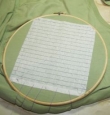
Waste canvas is a canvas that is held together with glue. It is used as an embroidery guide, and once the embroidery is completed the underlying canvas is dampened and removed, leaving the embroidery directly lying onto the ground material.


Chikan is a decorative technique from India, which became particularly popular due to the patronage of the Nawabs of Oudh (with Lucknow being the capital) in the nineteenth century. It is often also known as chikankâri (' chikan-work'). Its origins are shrouded in history, but it may well have originated in the Mughal period.

Torchon lace is one of the most common forms of bobbin lace, and perhaps also the simplest. Ground and motifs are made at the same time, in strips of 2.5 to 5 cm wide. Use is made of a relatively thick thread. The motifs are simple. It is a strong type of lace originally made of linen, but cotton is also being used. The motifs are often outlined with a gimp thread. Originally hand-made, torchon lace is machine made since at least the early twentieth century.
More...

Mechlin lace (Dutch: Mechelse kant) is one of the oldest and most delicate forms of bobbin lace produced in Flanders, Belgium. It is made without pins. Its name derives from that of the town of Mechelen. This type of lace was used mainly to decorate (women's) clothing, and remained popular until the beginning of the twentieth century, mainly being worn, because of its open appearance, over clothing of a different colour.