
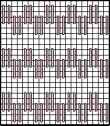
The term Algerian filling stitch is sometimes, in the case of free-style embroidery, used as a synonym for the long and short stitch. In canvas work, the term is often used for blocks of two or more vertically worked stitches over four threads, and with a second block being worked two threads up (or down), thus creating a staggered pattern.
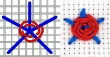
A spider's web is a composite stitch that creates a raised, circular shape. First a foundation of straight stitches is made, working outwards from one point, creating a spoked wheel-like design. Then another thread, sometimes of a different colour, is threaded in a circle, under and over the spokes of the wheel, starting from the centre and working outwards. There are various variants of making the spoked wheel.
Various styles of decorative needlework from Europe and North America use a narrow ribbon rather than a thread to create the required stitches and/or pattern. Ribbon work may be worked in combination with embroidery thread, such as floss silk, perlé cotton and/or mercerised 6-stranded thread.
In the late nineteenth century, China ribbon work was a form of drawn thread work, into which coloured China ribbons were run instead of cotton threads.
China ribbon embroidery is a form of decorative needlework using narrow China ribbons instead of an embroidery thread of some kind.

China ribbon is a term for a narrow, inexpensive ribbon (between 1.5 and 3 mm wide), which is sold since the nineteenth century in various colours, as well as in shaded forms. It is and was used for threading women’s underwear, children’s dresses, book markers, as well as for various types of ribbon embroidery, including China ribbon embroidery.
More...
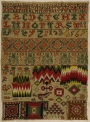
An English sampler made in AD 1749 by an unknown embroiderer includes examples of Florentine work, notably three variations on the flame pattern. These are worked in black, green, red and white woollen thread on a linen ground.

The flame stitch is a form of straight stitch used for Florentine work. The stitch is normally worked over a basic unit of four threads (variations in this number do occur) in the ground material. The stitches are worked in a series of stepped, coloured ziz-zag lines to create the effect of ‘flames’ or other motifs (such as ovals and a stepped pattern).

Bargello quilts represent an American tradition, in which the 'flames' and other patterns associated with Florentine work (known in America as bargello work), are imitated by using either small squares or strips of cloth.