
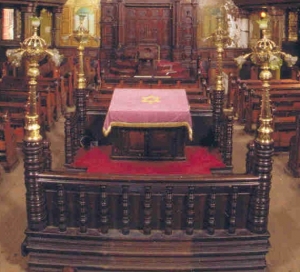
A bimah (Hebrew; pl. bimot; also called an almemor, almemmer or an almemmor) is an elevated platform in the centre of a synagogue. It is used when reading from the Torah, the Jewish holy book. When not in use, the bimah is frequently covered with a decorative cloth, the bimah cover, which is often embellished with metal thread embroidery.

'The Maiden's Chamber' is an English book illustration from 1840 depicting a young lady’s room. The print shows a young woman at her desk with a book in her hand. The print (a steel engraving) is based on an image by the English painter Alfred Edward Chalon (1780-1860) and was made by the artist and engraver, John Jewell Penstone (1817-1902).
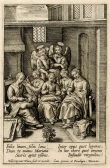
An image by the Flemish print maker, Hieronymus Wierix (1553-1619; at the bottom of the print is the text Hieronymus Wierx fecit et excudit) shows the Virgin Mary. The print dates to 1619 or earlier. It depicts the Virgin seated while sewing, surrounded by other young women sewing and embroidering.
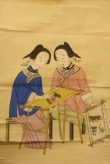
A nineteenth century hanging scroll now in the British Museum (acc. no. 1941,0311,0.1) in London depicts two Han Chinese girls working on pieces of embroidery. One of the girls is using a rectangular stand frame and is embroidering a design of flowers. She is wearing a more formal jacket with embroidered collar and front opening band, with a pink skirt. This type of skirt was often embroidered as well.
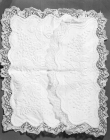
Mountmellick embroidery (or Mountmellick work) is a type of whitework associated with the southern Irish town of Mountmellick. It is sometimes called Mountmellick lace, but this is incorrect as it does not include the holes associated with bobbin or needlelace.
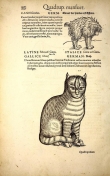
The Icones Animalium is a mid-sixteenth century natural history book by the Swiss naturalist and bibliographer, Conrad Gesner (1516-1565; also known as Konrad Gesner, Conrad von Gesner, other spellings also exist). The book was first published in Zurich in 1553.
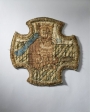
The so-called catte embroidery of Mary Queen of Scots is a slip in the form of a cross, decorated with an embroidered figure of a ginger cat that is wearing a crown and is playing with a mouse, on a checked floor. The catte embroidery is now in the Royal Collection, London. It was worked by Mary, Queen of Scots (1542-1587; her monogram of a combined MA can be seen to the left of the cat).

Stumpwork is a form of embroidery whereby the stitches form figures that are raised from the ground material. The figures can be made around pieces of wire and take the shape of humans, animals, birds, petals, leaves, insect wings, etc. Another method uses layers of cloth or felt that are used as padding underneath the stitches. Stumpwork can use a wide variety of techniques, including beadwork, goldwork, needlelace etc.

Opus teutonicum is a style of whitework embroidery popular during the medieval period in various parts of Europe that later became part of Germany, notably Lower Saxony, Hesse and Westphalia. It was also popular in parts of Switzerland and southern Scandinavia.

Opus anglicanum is a Latin term that literally means 'Work of the English'. The term is documented in medieval sources from the continent (not from England !) to describe the highly regarded goldwork embroidery from England, whether it was religious or secular.
More...

A coffin quilt is a type of North American quilt that seems to have been developed in the nineteenth century. In general, they are made out of dull coloured cloth with a simple design. They often have either a black border and/or a black central panel ('the cemetery'), as well as the name of the person who has died, which is included in the design.
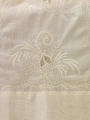
Ayrshire whitework, or Ayrshire work (from the county of Ayrshire, southwest Scotland), is a form of embroidery in fine muslin, decorated with fine lace filling stitches using a very fine thread with the main design in satin stitch and beading stitch.

St. Gallen embroidery is the common name for (machine) embroidery, often a form of whitework, which is produced in St. Gallen, Switzerland. By the early twentieth century, embroidery production was the largest export product of the country. The First World War led to a steep decline. Nowadays, St. Gallen Spitzen, as it is called in German, is a highly prized product, especially with the famous haute couture houses in Paris.
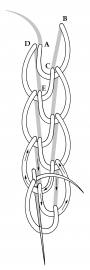
The double chain stitch is a variation on the chain stitch, in which two stitches are worked side by side while interlocking with each other. The double chain is created by bringing the needle out at A and then inserting it at B. The needle is then brought out at C to create an open chain stitch. A similar stitch is worked to the left. The third stitch is worked by inserting the needle into the first chain just to the right of C and so on.