
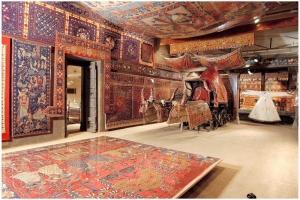
The Calico Museum of Textiles, Ahmedabad (Gujarat, India), houses a major collection of both hand and industrially produced textiles from India, which range in date from the fifteenth to the twentieth centuries. The Museum itself dates to 1949 and was set up by the industrialists, Gautam Sarabhai and his sister, Gira Sarabhai. Their family owns a large calico printing works, called Calico (also known as the House of Calico).

In March 1900, the exhibition 'Old Samplers and Tapestry Embroideries' was held at the Fine Art Society, London. The exhibition was curated by Marcus Bourne Huish, together with a lady called Mrs. Head (author of The Lace and Embroidery Collector) who gave details about techniques and stitches. The exhibition included samplers made by the Brontë sisters and by the mother and grandmother of John Ruskin.
Marcus Bourne Huish was an English writer and collector of embroideries, especially samplers. Huish is particularly known for his book, Samplers and Tapestry Embroideries (1900, London: Longmans, Green and Co.).
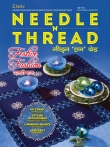
Needle n Thread is an Indian needlework magazine that was started in the late 1990’s. It is produced four times a year by Coats Crafts India. The magazine covers traditional Indian styles of needlework, as well as a wide range of textile handicraft techniques and designs from around the world.
Needle and Thread was an English decorative needlework magazine set up by Mrs. Grace Christie in 1914.
Grace Christie (née Chadburn; often known as Mrs. A.G.I. Christie) was an English writer and teacher on embroidery techniques and embroidery history. She is regarded as one of the most influential people in the early twentieth century with respect to the development of embroidery and embroidery studies in Britain and elsewhere.

The Christian Catholic Church venerates hundreds of saints, many of whom have become officially recognised as patron saints of various groups, guilds, occupations, and so forth.

A sari is a woman’s garment made out of a long length of cloth. It is particularly associated with Hindu women living in the Indian subcontinent and among the Indian diaspora. A sari can vary in length from 4 – 9 metres and may be between 60-120 cm wide. This variation is due to regional differences in form, as well as differing methods in how it is worn (depending on the social group of the wearer, daily or ceremonial occasions, dance, etc).

The House of Worth was a French fashion house that specialized in haute couture. It was founded in 1858 by Charles Frederick Worth (1825-1895). The fashion house was based at Rue de la Paix 17, Paris (France). Charles Worth was an English designer who used to work for various dry-good shops in London before moving to the dry-good and dress making firm of Gagelin et Opigez (Paris) in 1846.

The Arts and Crafts Movement is a late nineteenth century artistic style that took its name from the Arts and Crafts Exhibition Society (London), which was founded in 1887. The movement was inspired by the theories of the architect Augustus Pugin (1812-1852) and the art writer John Ruskin (1819-1900). The artist/craftsman William Morris (1834-1896) was also involved in its creation and propagation of the views of its members.
More...

Powdering is a term used to describe the ornamentation of a piece of cloth or other material by scattering and then stitching individual bracteates, jewels, small embroidered motifs, etc. This meaning of the verb ‘to powder’ dates back to the late medieval period in England. The Shorter Oxford English Dictionary gives a meaning of "to sprinkle or to spangle (a surface) with ...."
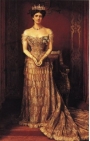
Lady Curzon’s Peacock Dress is an elaborately embroidered garment dating from the early twentieth century. It was worn by Lady Mary Curzon (1870-1906) at the Coronation Ball of the Delhi durbar of 1903. The dress is currently kept at Kedleston Hall (Derbyshire, England), the ancestral home of the Curzon family (National Trust Inventory Number 107881).
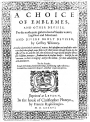
A Choice of Emblemes and Other Devises by Geoffrey Whitney is an English/Dutch emblem book, which was used as a source of inspiration for emblem embroidery in the late sixteenth and early seventeenth centuries. The book was dedicated to the Earl of Leicester, who at the time was the Lord Lieutenant of the English forces fighting against the Spanish who were occupying the Low Countries.
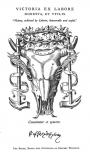
Geoffrey Whitney (c. 1548 – c. 1601) was an English scholar and compiler of an emblem book published in Leiden, The Netherlands in 1586. Whitney was born near Nantwich (Cheshire, England). His father is believed to be Sir Robert Whitney. Geoffrey Whitney went to Magdalene College, Cambridge University and later Oxford University.