
Chikankâri literally refers to the making of chikan, a form of Indian whitework and shadow work.

'Anjuman' is a 1986 Indian Hindi film drama directed by Muzaffar Ali. The film is set in Lucknow, India, and deals with the exploitation of women and the problems of the local chikan embroidery workers.
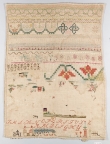
Most Western style samplers are made from a cloth ground with various forms of stitching or patterns worked onto it. Sometimes they also include beads or samples of beadwork (such as a nineteenth century Mexican sampler now in the Metropolitan Museum of Art, New York, acc. no. 57.122.264).
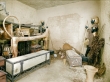
The ancient Egyptians used a comparatively narrow range of decorative embroidery stitches. Identified to date, these are the blanket stitch, chain stitch, running stitch, satin stitch, seed stitch, stem stitch and the twisted chain stitch

Omvendt Udklipshedebo (reversed Udklipshedebo) is a form of whitework embroidery using cutwork and embroidered lace techniques. It was developed in Denmark as part of the Hedebo tradition. It was worked on a white, linen ground (tabby weave) with white linen thread.

Hedebo rings constitute a characteristic circular pattern found on some types of the Hedebo embroidery from Denmark. They are normally worked separately in buttonhole stitch, linked together and attached to the linen.

Hvidsøm is a form of whitework embroidery using drawn thread and cutwork techniques, developed in Denmark and belonging to the tradition of Hedebo embroidery. It is also often classed as a form of embroidered lace. Traditional Hvidsøm can be recognized by its one or two rows of chain stitches that frame the main motifs. Originally Hvidsøm was made by the women of the small farming communities in the Hedebo region of Denmark.
More...

Straight furrow is an American quilting term for a quilt design made up of stripes of light and dark cloth. Straight furrow is very similar to the design of the more well-known log cabin quilt.

Hardanger embroidery (Hardanger work) is a general term for various forms of counted thread and whitework that were originally produced in Norway. Hardanger work derives from the Hardanger district in the western part of the country. Traditional Hardanger work is characterised by the use of a white, even-weave cloth (sometimes with double warp and weft threads) with a fairly thick, white cotton or linen embroidery thread.
Short shades are a nineteenth century term for a type of Berlin wool thread, in which the same colour changes from light to dark over a distance of less than a metre.
Long shades is a nineteenth century term for a type of Berlin wool thread, in which the colour gradually changes from light to dark over a long length of the thread.