

The detached chain stitch is a form of free style embroidery, which can be used to create one or more isolated small loops on the surface of the ground material.
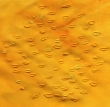
The link powdering stitch is a free style embroidery technique, whereby the ground material is partially covered with detached chain stitches. The stitches are normally worked in horizontal rows with the individual stitches placed in an off-set manner (alternating) over the space to be filled. This is done in order to give a ‘powdered’ effect.

The Cretan stitch is worked by inserting the needle into the ground material and then bringing it up a few millimetres directly underneath.
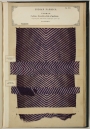
The Collections of the Textile Manufactures of India is a series of books on the textiles and textile production in India from the second half of the nineteenth century. The books are particularly noteworthy because they contain c. 700 samples of actual textiles and a description of each piece. The volumes were printed for the India Office under the editorship of Sir John Forbes Watson.
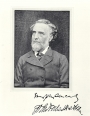
Dr. John Forbes Watson (1827-1892) was a British physician who initially, from 1850, worked for the Bombay Medical service. In 1858 he was appointed Director of the The India Museum in London, and Reporter for the Products of India at the India Office. He held the appointments until 1879. He was involved in the Indian sections of International Exhibitions held in Europe, including London 1862, Paris 1867 and Vienna 1873.
More...

For many centuries, trade links have existed between China and the west coast of India. It is not surprising, therefore, that a number of Chinese craftsmen, including embroiderers, settled in India, including Surat (north of Mumbai [Bombay]) from at least the nineteenth century onwards.

Strapwork is a stylised and ornamental representation of leather straps. Strapwork was popular in sixteenth and early seventeenth century Europe and was revived in the nineteenth century. A strapwork design consists of a series of bands worked into geometric patterns of varying degrees of complexity. This style of work was used for architectural details, stucco panels, as well as for textile and embroidery designs.
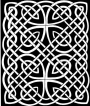
Knotwork is the interlacing of one or more bands, straps, or threads, in such a way as to create a decorative effect. It was a popular decorative style in sixteenth century Europe and was used for architectural features, paintings, pottery, as well as textiles, including decorative needlework. It is still sometimes used.

An initial stamp is a small instrument, usually with a wooden handle, which has a single (decorative) initial carved into it. The inscribed end of the stamp is covered with a washable ink (usually in black or dark blue) and pressed on a textile or garment in order to mark it. Often the printed design is then embroidered.