

The Bradford Khaki Handicrafts Club was established in 1918 to provide occupational therapy and employment for men returning from the First World War (1914-1918). Among the handicrafts provided was embroidery.
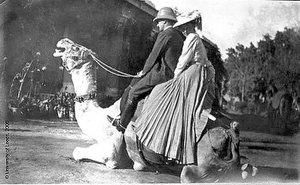
Louisa Frances Pesel (1870-1947) was born in Bradford (W. Yorkshire, England), the daughter of Bradford merchant Frederick Robert Pesel and his wife, Isabella. She was educated at Bradford Girls’ Grammar School. Louisa Pesel was a distinguished scholar, practitioner and teacher of the art of embroidery.
The International Textile Collection was formerly, until 2019, known as the ULITA Archive of International Textiles. It now forms part of Special Collections, Leeds University Library.
A composite stitch is made up of two or more different stitches. This type of stitch is sometimes referred to as a compound stitch.

Limerick tambour lace is a form of embroidered net lace, made with a machine-made net (tulle) and using chain stitch and a tambour hook for decoration. It should not be confused with Limerick run lace. It was made in Limerick, Ireland, from about 1829, when Mr Charles Walker set up a lace manufacturing business.
More...

The Wrongs of Woman is a nineteenth century novel by the English writer, Charlotte Elizabeth Tonna (1790-1846; she wrote as Charlotte Elizabeth), about the life of lace embroiderers in England. Tonna wrote several books on the contemporary social and economic conditions of women.

The term lace runner can be used in different ways. It was, for example, a nineteenth century English term for a person who hand embroidered lengths of machine net with darning stitches or running stitches. The term can also be used for strips of net or cloth, such as linen decorated with lace or embroidery of some kind. These were intended to run down, for instance, a table centre. Sometimes these strips are mistaken for stoles.
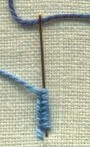
The drizzle stitch creates a form of knot comparable (but not identical) to a bullion stitch (bullion knot). The drizzle stitch is used in Brazilian dimensional embroidery.