
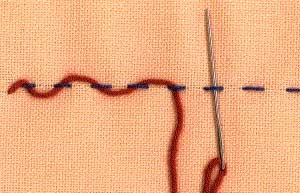
Threaded stitches, also known as laced stitches, are a group of stitches characterised by a 'foundation’ stitch that is combined with a second thread.
Canvas embroidery is a form of counted thread embroidery, in which decorative stitches are worked on a canvas ground to create a dense pattern that covers much of the ground material. There are various forms of canvas work such as Berlin wool work and Florentine work.
Surface embroidery is an American English term for a form of free style embroidery.

Defining and cataloguing a piece of embroidery is always subjective and often depends on the reason why someone (artist, collector, producer, seller, user) is trying to define a particular object. For the purpose of this encyclopaedia it was regarded as necessary to at least attempt to present various definitions of embroidery styles and techniques that can be found throughout the world.

There are different forms of stitching, depending on whether the primary aim is structural or decorative. With respect to structural sewing, if a sleeve, for example, is sewn onto a garment with stitches and then these are removed, then the sleeve will fall off.
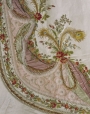
There are various definitions for decorative needlework and these have changed over time. For the purpose of this encyclopaedia, the term is used as an umbrella concept that includes a range of decorative textile techniques, such as applied decoration, appliqué, beadwork, embroidery, patchwork and quilting.

A dalmatic is a garment used as a Christian Church liturgical vestment. It takes the form of a long, wide-sleeved garment, often open at the sides, having become almost identical with the tunicle. The colour of the dalmatic varies according to when it is worn within the Church calendar (see: Christian liturgical colours).
More...

An alphabet sampler carries the alphabet as its main feature. This is a form of sampler that became popular in the seventeenth century in northwestern Europe. Often the alphabet is repeated in low case, high case and in various fonts. It should not be confused with a marking sampler, in which a simple alphabet in capital letters is embroidered.

Elizabeth Parker (1813-1889) lived in Ashburnham, Sussex (England). She was the daughter of a local labourer. Elizabeth Parker produced a unique text sampler, which contains a long lament about a teenager’s life in the first half of the nineteenth century. She became a teacher at the Ashburnham Charity School and raised her sister’s daughter. She died in the Ashburnham Almshouses in 1889, aged 76.

A text sampler is a form of sampler, in which the main design consists of a text rather than a series of decorative patterns or stitches. This type of sampler developed in northwestern Europe in the mid-seventeenth century and was especially popular among the Protestants. The texts often are orthodox moral or religious quotations. This form of sampler was spread around the world via British colonists, especially in North America.

There are many definitions, concepts and pre-conceptions as to what exactly constitutes a piece of lace. Some people regard bobbin lace as 'true’ or ‘pure’ lace, all other types being imitations or not even lace.