

A mitre (Greek: μίτρα, 'headband' or 'turban') is a Christian liturgical vestment, generally triangular in shape, which may take different specific forms. Mitres have long been worn by Christian bishops and abbots in many Anglican, Catholic and Orthodox Churches. Since the medieval period, mitres have often been made from decorative woven and/or embroidered material.
A memorial card records the death of a family member or friend. These cards were especially popular in Europe and the Americas in the nineteenth century.

Linsey-woolsey (also called woolsey-linsey) originally referred to a textile made with a flax warp and a wool (worsted) weft. Later it came to mean a material of coarse, inferior wool (weft), woven with a cotton warp. It generally came in plain blue or white, or with blue and white stripes. The name linsey is associated with the Suffolk (UK) town of Linsey, where this type of cloth was woven.
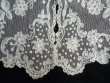
Limerick lace is a form of embroidered net lace from Ireland. The technique uses machine-made net and was introduced to Limerick in 1829 by Charles Walker (d. 1842). He brought over twenty girls from Coggeshall, Essex (England) to set up a lace-making school.

Liberty is a large shop on Regent Street, London. It is known for selling luxury goods, including a wide range of patterned materials that are known as the Liberty Art Fabrics collection. The patterns are often known simply as 'Liberty Prints.' The shop was set up in 1875 by Arthur Liberty (1843-1917), and sold materials, ornaments and other items from Asia, especially China and Japan.
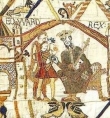
In a medieval written inventory, reference is made to an embroidered mantle of King Edward the Confessor (r: 1042-1066), the last Anglo-Saxon king of England. King Edward is depicted at the beginning of the Bayeux tapestry.
Flowerer is a nineteenth century nickname given to a woman who made Ayrshire whitework embroidery, which was well known for its floral motifs, hence the name.
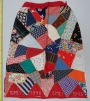
The feestrok ('celebration skirt') is a patchwork skirt, now in the collection of the Textile Research Centre (TRC) in Leiden, The Netherlands. Also known as a bevrijdingsrok ('liberation skirt'), the TRC feestrok is one of many comparable garments made in order to celebrate the liberation of the Netherlands in May 1945 from German occupation at the end of World War II (1939-1945).
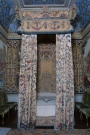
In northwestern Europe, between the sixteenth and nineteenth centuries, very elaborate bed dressing systems were developed among the elite in order to display their status. These beds were known as full-testers. They were provided with four columns at each corner, which held up a roof of some kind. There were also ‘cheaper’ versions, called half-tester beds, whereby the ‘roof’ or tester only covered the head end of the bed.

The Encyclopédie des Ouvrages de Dames is one of the most famous nineteenth century European decorative needlework encyclopaedias. It was written by Thérèse de Dillmont and first published in 1886 by Dollfus, Mieg et Companie (DMC; Mulhouse, France [at the time in Germany, 1871-1918]).
More...

Needle lace is a general term applied to various forms of lace made with a needle, including embroidered lace, embroidered net lace and needlepoint lace. See the schematic survey of lace forms. See e.g. Puncetto.

Embroidered lace is a general term for a needle lace that is made with a needle and thread on a woven ground, rather than on a (knotted) net ground, which would result in what is classed as embroidered net lace. Extant pieces of embroidered lace represent the earliest examples of European lace and date back to the fourteenth century. The four main forms of embroidered lace are:
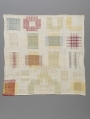
A feature of North European domestic needlework is the production of darning samplers. Darning samplers were made in Belgium, Britain, Denmark, Germany and the Netherlands between the eighteenth and early twentieth centuries. They were usually made by school girls as part of their education, either at home or in a school class.

Crochet is a form of lace worked with a hook and a continuous thread. The English word comes from the French crochet for a small hook. Crochet consists of a series of individual loops comparable to a chain stitch, which are combined in a number of different ways to produce various lacy effects.