

William Morris was an English architect, designer, publisher, social activist and writer, who was involved in a number of significant changes in English textile forms, including embroidery, during the nineteenth century. Morris and a group of influential, London based artists called the Pre-Raphaelites, were instrumental in the revival of traditional crafts production techniques.

A rail fence is a striped pattern used for making quilt tops. A rail fence block is made up of three strips in different colours joined together to make a square of about 10 x 10 cm. The blocks are sewn together with the differently coloured stripes of the blocks in alternating vertical and horizontal directions. The blocks are then joined together to create the entire quilt top. The result is a form of patchwork quilt.
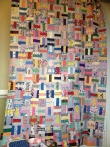
Hap is an American word, used especially in Pennsylvania, of Scottish/Northern English origin for a thick padded quilt. The word is common in those areas where Scottish and Northern English settlers lived in the eighteenth and nineteenth centuries. They named the Pennsylvania counties of Cumberland, Westmoreland and Northumberland after northern English counties.
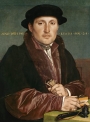
'Portrait of a Young Merchant' or 'Portrait of a Young Man at his Desk' is a painting by Hans Holbein the Younger (1497-1543). It dates to 1541 and measures 46.5 x 34.8 cm. The man is depicted wearing rich, but subdued clothing, including a black fur coat with short sleeves. The shirt is pulled into small gathers around the neck and fastened into a collar band decorated with blackwork with a design in dull yellow.

'Portrait of an Unknown Woman' is a painting, dated 1564, by the German artist, Lucas Cranach the Younger (1515-1586). It portrays a rich, but now unknown young woman wearing an elaborate outfit with many heavy golden chain necklaces. Her elaborate gown in black, red and white includes various items of embroidery, notably her sleeve cuffs and matching front waist band.

Tapissier is a French term that is sometimes incorrectly associated with an embroiderer or stitcher. Originally the term tapissier was used to describe someone who wove tapestries. By the sixteenth century the term also included anyone who mended tapestries.

S’Jacob’s christening veil is an embroidered net veil given to the Dutch family of s’Jacob in about 1821 by Princess Anna Paulowna (1795-1865), daughter of Tsar Paul I of Russia and wife of (the future) King Willem II (r: 1792-1849) of the Netherlands.
More...

The Sybil Carter Indian Lace Association is an early twentieth century USA group that organised schools for teaching various types of lace making to native Americans. The first school was set up by Sybil Carter in about 1889, following an invitation by Bishop Henry Whipple for her to teach lace making to Ojibwe women in the White Earth Reservation (northwestern Minnesota).

The Singer Sewing Machine Company was founded by Isaac Merrit Singer (1811-1875), an American inventor and businessman. Singer had a long and varied career. He initially moved to Boston (USA), a centre for the printing trade, where he tried to find financial backers for his type-carving machine. He rented a workshop from Orson Phelps, who built and repaired Lerow and Blodgett sewing machines.

The Singer sewing machine is a brand of domestic sewing and embroidery machines developed in the mid-nineteenth century in the USA.
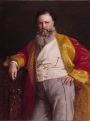
Isaac Merrit Singer was an American inventor and businessman who was involved in the development of hand sewing machines and the Singer sewing machine. Singer was born in Pittstown, New York, the son of German immigrants. He worked as a mechanic and cabinet maker, then as an actor in a travelling troupe. Singer's first patent, in 1839, was for a machine that drilled rock.