
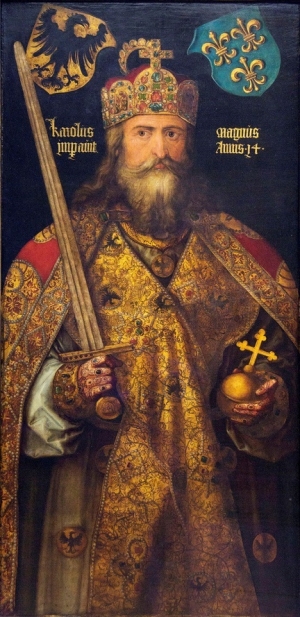
Albrecht Dürer (1471-1528) painted an imaginary portrait of Emperor Charlemagne (d. AD 814). Charlemagne is probably wearing the embroidered garments that are still extant and are associated with later rulers.

Cuesta Benberry (1923-2007) was a teacher in St. Louis, Missouri (USA). She began studying quilting after a visit to her husband’s family in a small village in western Kentucky. She was struck by the pride the women showed in their quilts and by the names of the block patterns (for example, flying geese, carpenter’s wheel, schoolhouse, ocean’s waves, etc.).
In the USA, batting is the general term for the middle layer, or filling, of a quilt or quilted item. Examples of batting include wool left over from shearing, rags, used clothing or blankets, cotton or polyester. The UK term for batting is wadding. The upper cloth layer of a quilt is known as the top or top layer, while the bottom is known as the lining or backing.
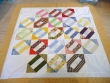
Autograph quilt is an American term for a type of commemorative quilt. These quilts come in two forms, friendship quilts and album quilts. Friendship quilts are informal, single pattern quilts; album quilts, or sampler album quilts, are regarded as being more formal in nature. In both cases, however, the characteristic feature of this type of quilt is the presence of numerous signatures of friends and family members.
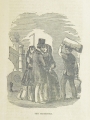
Aunt Eliza's Garret is the title of an 1854 melodrama by G. M. Viner, on how drinking, bad business skills and an even worse choice of friends could reduce a family to poverty, forcing its 'respectable' female members to become 'needlewomen' in order to make a semblance of a living.

There is a reference to what may have been (Attalic) embroidery, which was probably a form of goldwork embroidery, in Pliny the Elder’s (AD 23-79) Naturalis Historia. This series of encyclopaedic books was probably completed in c. AD 77.

A bodkin is a thick, medium length needle of between 4-6 cm in length, which has either a rounded and blunt, or a pointed end. This type of needle may be round (also called ballpoint) or flat in section (threader). It has a long, elongated eye. Some bodkins have two or more eyes.
More...

A leather needle is a long needle (between 6-10 cm in length), with a long eye and a characteristic sharp triangular point. This shape enables it to pierce and pass through leather, suede and vinyl, without tearing the ground material.

The open fishbone stitch is often used to fill a leaf or shape. It is very similar to the fishbone stitch, but there is a gap between the individual elements of the stitch.

The fishbone stitch is often used to create and fill a leaf design or comparable shape. In order to work the motif, first a line of tiny dots is drawn down its middle. Then the thread is taken in and out of the ground material in such a way that a stitch is created that resembles a fishbone, and when made in a series creating the desired (leaf) design.

Ghabani embroidery is a form of chain stitch work from Syria, which is carried out with a hook rather than a needle. It probably derives from the Indian ari embroiderytradition. The word ghabani can be used for both this form of embroidery and for the end product decorated with this type of embroidery.