
The trammed half cross stitch is a canvas embroidery stitch worked on double-mesh (double thread) canvas.

The long-armed cross stitch is a canvas embroidery stitch, where one arm of the cross is much longer than the other. On the reverse side of the ground material the stitches form a series of short lines set at a right angle to the direction of the cross stitches on the obverse. The same stitch is sometimes called a long-legged cross stitch, twist stitch or plaited Slav stitch.
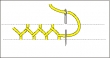
The open Cretan stitch is closely related to the feather stitch, and is worked with the needle at right angles to the line of the embroidery.
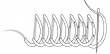
The buttonhole stitch (also known as button stitch) is a technique used in embroidery and for embroidered lace. It is very similar to the blanket stitch. It is called buttonhole stitch when the stitches are packed closely together and blanket stitch (USA: blanket edge) when they are more evenly spaced out.
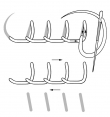
The blanket stitch is a technique used in various forms of embroidery. It is very similar to the buttenhole stitch and it also uses two levels. It is called buttonhole stitch when the stitches are packed closely together, and blanket stitch (USA: blanket edge) when they are more evenly spaced out.

The satin stitch is a widely used embroidery technique worked in close, parallel rows. They are used to fill in all or part of a design. The term satin stitch derives its name from its similarity to the shiny appearance of satin cloth, especially when a floss silk or a mercerised cotton thread is used for the embroidery.

The surface satin stitch is a technique whereby the stitches are worked in close, parallel rows. They are used to fill in all or part of a design. At first glance, the surface satin stitch looks like the satin stitch, but instead of the stitches being taken across both the surface and reverse of the ground material, a surface satin stitch only covers the surface of the cloth.

The padded satin stitch is a form of satin stitch, whereby the stitches are used to cover a number of small, isolated straight stitches in the design area. This technique gives a raised effect. The padded satin stitch is also called the raised satin stitch.
More...

A seed stitch (also known as isolated back stitch, seeding stitch, seed fillling stitch or speckling stitch) is in fact a series of tiny straight stitches or back stitches taken at all angles and in any direction, but more or less of an equal length. These small stitches are used to fill in either part of a design or the ground. To be effective the stitches are normally placed quite irregularly and without making any pattern.