
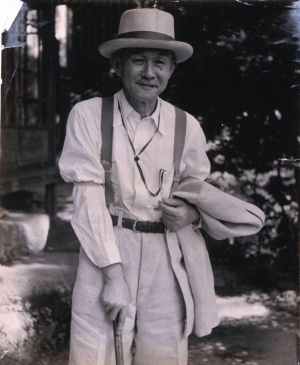
Soetsu Yanagi (1889–1961), also known as Yanagi Muneyoshi, was a Japanese philosopher and founder of the Mingei (folk crafts) movement in Japan in the late 1920's and 1930's. During this period, Japan was going through rapid westernization, industrialization and urban growth. The Mingei movement was regarded as a reaction to this rapid modernization.

During the twentieth century, a major influence on Egyptian decorative needlework was the work of Habib Gorgi and his son-in-law, the architect Ramses Wissa Wassef. Both believed that children were (and are) endowed with creative powers and potential that should be encouraged. In 1951, Wissa Wassef established the Ramses Wissa Wassef Art Centre, near the Giza pyramids.
Ramses Wissa Wassef was an Egyptian architect and professor of art and architecture at the College of Fine Arts, Cairo. He and his father-in-law, Habib Gorgi, believed that children were (and are) endowed with creative powers and with a potential that should be encouraged.
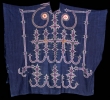
The Tuareg are an ethnic group who live in the Sahara Desert, North Africa. They call themselves Kel Tamasheq, Kel Tamajaq or Kel Tagelmust (‘People of the Veil’). In general, they are not known for their embroidery, although there are a few garments, especially worn by those who live in the south, that are decorated in this manner.
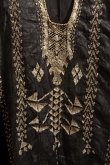
Telli is a form of metal thread embroidery from Egypt, Lebanon and Syria. It uses thin strips of metal thread to make herringbone stitches, satin stitches and detached Roumanian stitches. The metal thread appears on both sides of the ground cloth. This style of work is directly linked with metal thread work from the former Ottoman Empire. This technique was used to decorate a range of garments, such as dresses and shawls.
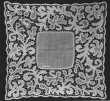
Tape lace is a form of lace using either a hand made (with a bobbin) or a machine woven tape. The tape is folded into the required design and then fixed and embellished with connecting lace or embroidery stitches of various kinds. Tape lace is traditionally used for the corners, borders and centre piece of a table cloth, as well as for veils, dress collars, parasols, fans, handkerchiefs, napkins, doilies, and so forth.

The Street of the Tentmakers is located in the Shari Khayyamiya (or Suq Al-Khayyamiya), Cairo, Egypt. It is famous for the production of appliqué panels, which were originally used to decorate tents and pavilions. The name Khayyamiya comes from the Arabic word khayma (‘tent’). The Street forms part of the district of Qasabat Ridwan.
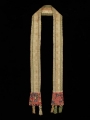
A stole (also known as the orarium) is the name of a Christian liturgical vestment in the western Churches. The term derives from Latin stola, in the meaning of equipment, array, clothing. A stole consists of a long band of cloth that is about 250 x 10 cm in size, whose ends may be straight or broaden out.
Spontaneous embroidery is a term especially used for various types of local Egyptian embroidery that are influenced by the Wissa Wassef principles of design.

A sinew (tendon) is a tough, flexible band of connective tissue that connects muscles to bone, in animals and humans. A sinew is made of numerous long fibres. Animal sinews, especially from deer, have been used in various societies where the main fabric used for clothing is leather. It is applied as a short thread for sewing fabrics together and for applying decorative beads, quills etc.
More...

A (sewing) needle is a small, slender and usually rounded tool used to carry a thread of some kind through a piece of cloth or related material, while carrying out plain (structural) or decorative sewing. A needle normally has a hole (eye) at one end and is shaped to a sharp or blunt point at the other.

In the early 1980's, excavations were conducted at a Christian cemetery near Selia (also spelt Seila in some sources), along the eastern edge of the Fayoum depression, Egypt. The excavations at Selia were directed by Wilfred Griggs, Brigham Young University, USA. The oldest monument in the region is a four-stepped pyramid dating to the early Third Dynasty (2686-2613 BC).
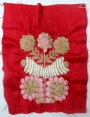
Rashq embroidery is the general name for a form of embroidery from the Delta of Egypt. It originated in a dense form of passementerie used in the nineteenth and early twentieth centuries in Egypt for Bedouin men’s waistcoats. Rashq embroideries are made using a sewing machine with one needle and two separate threads.
The top layer of a quilt is often made of identical or diverse series of design blocks. These blocks are made separately and then sewn together.