

Wadi Dawan is a desert valley in central Yemen, in the Hadramaut Governorate. During the twentieth century, brides from the Wadi Dawan often wore a wide dress with very short sleeves, a square neck opening and a train. The majority of the decoration is on the back of the garment. The decoration generally consists of appliqué cloth, sequins, as well as metal thread couching and embroidery around the neck opening.

A virago sleeve is a full, paned sleeve, used in the early seventeenth century in western Europe. It was made from a series of cloth strips, which were gathered into two puffs by a ribbon or cloth band just above the elbow. The main sleeve strips were often embroidered. This type of sleeve was fashionable for women’s clothing in the 1620's and '30's. GVE

The Supertunica, also called the Robe Royal, is a full-length, sleeved coat with a belt, made of gold silk cloth and with embroidery down the front opening. The Supertunica forms part of the coronation garments worn by British monarchs. The form of the Supertunica derives from one of the Christian ecclesiastical vestments, and is said to have been inspired by Byzantine garments.
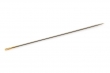
A straw needle is traditionally used in hat and bonnet making. It is long and fine, with a sharp point and a round eye that is not wider than the needle shaft. This type of needle is also often used for appliqué and smocking, as well as straw embroidery. Also known as a milliners needle.

Straw embroidery is a form of decorative needlework from the second half of the nineteenth century, which involved the sewing down of pre-cut straw forms onto garments. The shapes include butterflies, corn, flowers and leaves, and they were stamped out of straw. These were used to trim ball dresses and to decorate complete dresses, especially those made of black or yellow net.

A spreuer is a term sometimes used in straw embroidery for leaf shapes made by winding damp, milled straw splints between the teeth of a coarse comb of some kind.
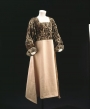
Smock is an obsolete English term for a garment now known as a shift or chemise. The word derives from the Old English smoc, cognate to Old German smoccho and Old Norse smokkr. In western Europe, from about the tenth to the sixteenth centuries, a smock was the undermost garment worn by women and many men. It was a loose T-shaped garment with a gathering thread or tape at the neck and at the sleeve edges.

The Stole Royal is a liturgical vestment worn by British monarchs at their coronation. It is worn with the Supertunica (Robe Royal). A stole is a long, narrow length of cloth that is worn around the back of the neck, with the two ends hanging down parallel to each other in the front. The Stole Royal is normally embroidered with gold and silver thread and may be set with jewels and pearls.
More...

The Robe of State, also known as Parliament Robe, is a long mantle worn by the British monarch when he/she enters Westminster Abbey for the coronation, and at the annual State Opening of Parliament. The garment, as worn by Elizabeth II, consists of an ermine cape with a long crimson velvet train (about 4.5 m in length), also lined with ermine. The train's top is decorated with two rows of gold lace and gold filigree work.
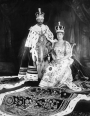
During the British coronation service, the sovereign wears a number of different garments, some of which are embroidered. One of the most elaborate and spectacular items is the Robe of Estate, which is a long, purple velvet mantle worn by the British monarch after the actual coronation.

Queen Victoria's Coronation Glove is an embroidered accessory said to have been worn at the coronation of Queen Victoria on 28th June, 1838. It has been suggested that this coronation glove is a replica and made between 1870-1876, rather than the actual glove worn at the coronation.

The Queen Elizabeth II Coronation Glove is made of leather with goldwork embroidery and was presented to Queen Elizabeth II at her coronation in 1953. It was made by the firm of Dents, glove-makers. The glove for the right hand of the monarch is made of white kid leather with the grain on the outside and lined with crimson silk.