
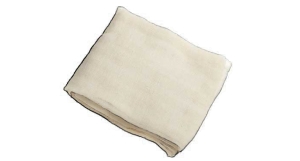
Tammy cloth is a coarse, union (a mixture of two different types of fibres) cloth made of cotton and worsted (wool). The word derives from tamis, which is a cloth originally used for sieving (see French tamis, ‘sieve’). It is also called tammies. It should not be confused with ‘tammy’, the abbreviation for a Tam o’Shanter, a form of woollen bonnet used in Scotland.

Tamis is a coarse worsted cloth, originally used for straining sauces. The term derives from the French word tamis (‘sieve’). It is now sometimes used as the ground material for coarse forms of embroidery. The word is also used for a sieve, especially for Indian cooking (also known as a drum sieve or chalni).

In the Siwa oasis, Egypt, brides traditionally wore a particular type of decorated footwear. It consisted of a pair of flat, red-dyed shoes made out of goat leather and decorated with embroidery. The older versions were decorated with floss silkor cotton perlé thread.

The Siwa oasis in Egypt has some very distinctive sartorial traditions, which include embroidered bridal dresses. A basic Siwa bridal dress takes the form of a large ‘T’ shape. It has long wide sleeves, with a ‘shoulder’ seam, which reach almost to the elbow.
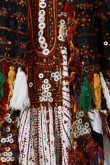
Siwa oasis embroidery is a distinctive form of decoration associated with the Siwa oasis, Egypt. Siwa is a major oasis (20 by 80 km) in the Western Desert of Egypt, which has been occupied since at least the first millennium BC.
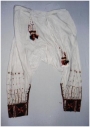
Bridal trousers (srawelin khatem) form part of the distinctive outfit traditionally worn by brides in the Siwa oasis, Egypt. They are made of white or black cotton and very wide around the waist and hips. The lower part of each trouser leg are decorated with panels of embroidery. The embroidery yarns used to be floss silk, but by the late twentieth century a rayon imitation of pure silk, perlé cotton or cotton threads were used.

Siwa is a large oasis in the Western Desert of Egypt, which has been occupied since at least the first millennium BC. Since the fourteenth and fifteenth centuries or earlier, the Swa or Ti-Swa people, a Berber group, have inhabited the oasis. Until the late twentieth century Siwa was one of the country’s most isolated settlements and over the centuries it developed a distinct culture.
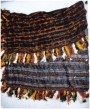
In the Siwa oasis, in the Western desert of Egypt, women used to wear two types of embroidered head and body coverings. The first type is a black bridal cover and is called a troket. The second is a large head and body covering worn by married women.

The Silver Jubilee Cope and Mitre is a set of an embroidered and appliquéd cope and mitre made to celebrate the Silver Jubilee of Queen Elizabeth II of England (r: 1952-) in 1977. They were designed by British embroiderer Beryl Dean and made by needlework students of the Stanhope Institute, London.
More...

The Sicilian Altar Frontal is an embroidered cloth in the collection of St. Paul’s Cathedral, London (acc. no. 5428). It was made in Sicily and dates to AD 1684. It is 275 x 101 cm in size and was given to the cathedral in 1932. The frontal is made from linen that is embroidered with metal thread and silk chenille thread.
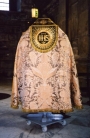
The Queen Victoria Diamond Jubilee Copes are a set of four copes with hoods made to celebrate the Diamond Jubilee of Queen Victoria of Britain (r: 1837-1901) in 1897. They were designed by John Thomas Mickelthwaite (1843-1906) and George Frederick Bodley (1827-1907). The copes were made from a cream coloured brocatelle with a blue linen lining.

A mola is a decorated blouse worn as part of the traditional costume of Kuna (Cuna, Guna, Quna) women in Panama. In Dulegaya (the Kuna language), the word mola means ‘blouse,’ ‘shirt’ or ‘clothing'. By the end of the twentieth century, however, the term mola had become almost synonymous with the decorated panels, on the front and back of the blouse, and hence with the associated technique of reverse appliqué.

The Japanese term mingei literally means 'ordinary people’s craft'. It is used for the Mingei movement, the Japanese version of the Arts and Crafts movement. The Mingei movement started in the 1920's and was led by the Japanese philosopher, Soetsu Yanagi (1889-1961).