

A laudian is a decorative piece of cloth that hangs over the altar frontal cloth on some Christian altars. The laudian is sometimes called an antependium, but the latter is a general term that means a hanging and is used to describe other church items as well.

Portrait of Mary Fiennes, Baroness Dacre (1524-1576), wife of Thomas Fiennes (9th Baron Dacre). The portrait of Lady Dacre is by the Flemish artist, Hans Ewouts (Eworth, c. 1520-1574; see also his portrait of Bess of Hardwick). The date of the painting is unknown. In her portrait, Lady Dacre is depicted wearing a smock decorated at the neck and sleeve cuffs with blackwork embroidery.

Katherine Parr (1512-1548) was the sixth and last wife of King Henry VIII of England (r: 1509-1547). She was portrayed in c. 1545 by a now unknown artist. The portrait is currently in the National Portrait Gallery, London, acc. no. NPG 4618. Katherine Parr was married to King Henry VIII from 1543 until his death in 1547.

IHS is a Christogram, an abbreviation of the name of Jesus Christ. IHS or IHC are the first three capital letters of the Greek name of Jesus, IHΣΟΥΣ (iota-eta-sigma), also sometimes written as ΙΗΣ. This is commonly used within the Western Christian churches. In the Eastern Churches, the Christogram ICXC is most widely used.
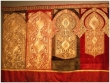
Hiti (hiti, hayti, from the Arabic hayt, ‘a wall’) is a form of wall hanging found in Morocco and sometimes in other parts of North Africa. Basically, a hiti is a long strip of material, about 15 m long and roughly 1.5 m wide, which is used to decorate the walls behind the divans that line meeting halls (majlis) on ceremonial occasions, especially weddings.

The Hirosaki Kogin Institute was established in 1942, initially with the name of Hirosaki Homespun LLC, as part of the NPO Kimura Industry Institute (est. 1932). It was set up to provide guidance and instructions to the newly developed local wool industry.

Conrad Gesner (1516-1565) was a Swiss physician and naturalist who published a five volume natural history book called Historiae Animalium (Zurich, 1551-1558). The series includes illustrations of birds, fish and mammals, and became a popular source of inspiration for embroidery designs in Europe in the sixteenth century and later.

A frontal is a decorative piece, usually of cloth, metal, stone or wood, which hangs or is placed in front of the altars of some Christian Churches. It is sometimes called an antependium, but the latter is a general term that can be used for any piece of textile, metal or stone hung or placed in front of other church items as well.

A friendship quilt is a form of single pattern quilt, usually made of several blocks with the same pattern. These blocks could be made quickly with each friend involved in the project, using fabric scraps available at home. In North America, a friendship quilt might be made as a gift upon a girl’s coming-of-age or marriage. Often the quilters sign their names on the block they made.
French canvas embroidery is a form of canvas embroidery that was popular in Europe from the 1880's onwards.
More...

Tulle-bi-telli is a form of metal thread embroidery, with that name particularly associated with Egypt, Lebanon and Syria. It uses individual knots made with lamé, and this technique in general is associated with many countries. In India, Pakistan, throughout the Gulf region and Saudi Arabia, the technique is usually known as badla. In Iran it is called khus-duzi. The term tulle-bi-telli (‘net with metal’) includes the French word tulle (‘net’).

A dossal is a decorative cloth displayed on the back of some Christian altars. The word dossal (dossel) derives from the medieval Latin dossale/dorsale (from dorsum, ‘back’). In traditional Catholic and Anglican churches, the altar is covered with various textiles including the frontal and laudian, which cover the front of the altar. The back of the altar is covered with the altar dossal or simply the dossal.

'Cathedral's broderer' is the official title of the embroiderers (professionals and volunteers) of St Paul’s Cathedral, London. They are responsible for the embroidered vestments and other textiles held by St Paul's Cathedral in London.

A canvas guide is a piece of cloth, the use of which was developed together with the advent of fine, machine woven cloth, when it became more difficult to produce counted thread embroidery.