

Buckskin is the soft preserved hide of an animal, such as a cow, deer, elk, moose or sheep. The English term ‘buck-skin’ derives from the word ‘buck’, meaning a male deer. The first recorded English use of the term dates back to AD 1433. Since 1804 the term has also specifically referred to a sheepskin that is processed in order to look like buckskin.
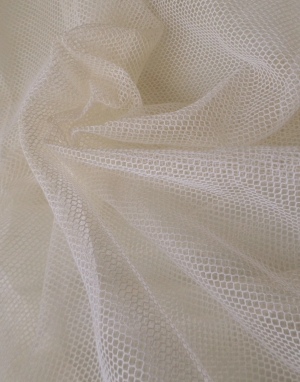
Bobbinet is a form of machine net (tulle) invented by the English engineer John Heathcoat in 1808. It is an imitation of the (hexagonal) net ground used in bobbin lace making. Bobbinet has an hexagonal mesh constructed by looping the weft thread around the vertical warp thread.
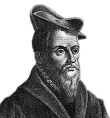
Pierre Belon was a French diplomat, explorer and naturalist. He travelled through Greece, Egypt, Arabia and Palestine between 1546 until his return to France in 1549. He is known for various books, among which Les observations de plusieurs singularitez et choses memorables trouvées en Grèce, Asie, Judée, Egypte, Arabie et autres pays étrangèrs (Paris, 1553).
An antependium is a decorative piece of cloth, metal or stone, which hangs or is placed in front of the altar, lectern or pulpit in a Christian church, and which is used by various Christian denominations. The cloth versions may be made of a decorative textile, such as brocade and damask, and it may be embroidered.

An American crazy quilt is a form of patchwork quilt, frequently lacking an inner batting, made of irregular shapes with no repeating motifs. Such quilts were often made of a mix of materials, for example, combining linsey-woolsey with calico or linen. Some authorities believe the crazy quilt’s roots lie in colonial America, when every scrap of fabric was utilized and re-used for as long as possible.
An altar cover is used on some Christian altars to protect it from dust and dirt and to draw attention to the most important element of the church. An altar cover is a length of cloth, usually rectangular (but square or shaped forms also occur), which is placed over the altar. It normally hangs down the front and back. Part of the altar is normally left visible.

The Al-Arish Needlework Project was founded in 1973 in Al-Arish, northern Sinai, Egypt, by the NGO, the Mennonite Central Committee of North America. It was set up in order to help Bedouin and village women to make a living by creating and selling needlework, notably embroidery and beadwork.

Akhmim is a city in Middle Egypt, which is historically known for its woven, and to a lesser extent embroidered and printed textiles. Thousands of textiles from the Roman period, and dating from approximately the third to sixth centuries AD, have been found in various excavations (official and unofficial). They were preserved due to the dry desert conditions.
More...
The word ‘wrought’ is a general English term that can refer to any decorated object, but it used to have a more precise meaning when applied to stitched items.

The Winterthur collection is kept in the Winterthur Museum, Garden and Library, in Winterthur, Delaware, USA. It was formerly known as the Henry Francis DuPont Winterthur Museum. Its Textiles and Needlework Gallery houses some 20,000 objects, including bed hangings, clothing, counterpanes, embroidered blankets, float-weave coverlets, Jacquard coverlets, quilts and samplers.