

Pouncing is a technique whereby the outline of a pattern is pricked on paper or card. This is done with a pin. Afterwards the pricked page is attached to a ground material and then rubbing soot or ground charcoal (on a light ground cloth) or chalk (on a dark ground cloth) is spread over the pinned paper and forced through the pin holes so that when the page is removed, a series of dots are left in place, facilitating the embroidering.

The Plymouth Congregational Church tapestry (Minneapolis, USA) is a commemorative embroidery based on the four seasons. The tapestry was commissioned by Mary and Paul Carson (he was then minister of the Congregational Church) and designed by the British illustrator, Pauline Baynes. The embroidery was started in 1971 and took about forty years for the four panels to be finished.
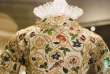
The Plimoth jacket is a recreated seventeenth century embroidered woman’s jacket. It was modelled on two such jackets now in the Victoria & Albert Museum, London. The jacket reflects fashionable items of clothing that were popular in the early seventeenth century and worn by noble and wealthy women.
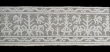
Punto Tirato is an Italian term for a form of drawn thread work, whereby one set of threads (usually the wefts) is removed. It was often used to create a more decorative hem.
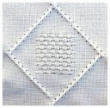
Pulled thread work is a form of embroidery in which the warp and weft threads of the ground material are pulled together to make small holes by tightening stitches. Also known as: pulled work, or deflected element embroidery (USA).
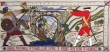
The Prestonpans tapestry is a commemorative embroidery, based on the theme of the battle of Prestonpans, East Lothian, Scotland, on 21st September 1745. The official title is 'The Battle of Prestonpans Tapestry 1745'. The embroidery was inspired by the Bayeux tapestry.

Point de Beauvais is a French term for a form of tambour embroidery, which is a decorative needlework technique using a hook to create a chain stitch. Tambour embroidery is believed to have originated in India, although China is sometimes said to be its home. It spread to Europe in the eighteenth century as a result of European trading contacts with India. By that time, point de Beauvais was developed.

The Plymouth tapestry is a commemorative embroidery based on a sixteenth century document recording the appointment of Plymouth’s first schoolmaster, Thomas Brooke, in 1561. The embroidery was designed by West Country artist, Tom Mor, in a cartoon style and includes figures, texts and names.

Phulkari is a counted thread embroidery technique from the Punjab and neighbouring districts in the northwest of the Indian subcontinent. The word literally means ‘flower working’. This work is normally carried out by women, sometimes for family members and on other occasions for commercial purposes. The work is carried out in a floss silk thread (pat) on a cotton ground (khaddar) using a darning stitch on the reverse side of the cloth.
More...
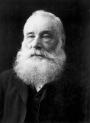
Sir William Henry Perkin was an English chemist who accidentally discovered the first aniline dye. Perkin was born in London and as a teenager studied chemistry under August Wilhelm von Hofmann (1818-1892), who was working on synthesising quinine as a treatment for malaria.


A pearl is a hard, iridescent object produced within the soft tissue of a living, shelled mollusc. A pearl is made up of calcium carbonate and layers of animal membrane (conchiolin). The ideal pearl is perfectly round and smooth, but many other shapes of pearls (baroque pearls) occur.