

Marking is a term that may refer to the use of an embroidered initial, monogram, number, shape or word to denote the maker or owner of an object, such as a napkin, tablecloth, or item of clothing. Marking was used to identify a person’s or family’s property, especially when something was sent to be laundered.
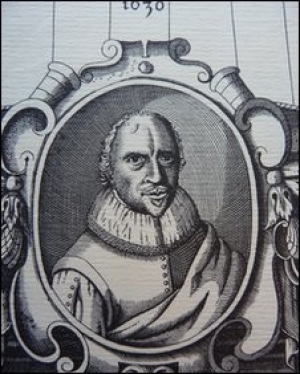
John Taylor was an English poet nicknamed 'The Water Poet’. He was born in Gloucester, but spent much of his life as a waterman in London, ferrying passengers across the River Thames. He also served in the English navy. John Taylor was politically active and wrote various pamphlets, especially in support of the watermen.

Punch needle embroidery (also known as needle punching, needle punch work, punch needle work, punch work, or igolochky) is a technique involving the punching and looping of a thread or ribbon (c. 2 mm in width) in a particular design through a ground cloth.
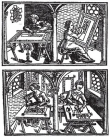
Alessandro Paganino was an Italian artist and writer from the early sixteenth century. In 1518 (reprinted in 1527 and 1538) he published a pattern book called Il Burato, Libro de Recami ('Buratto, a Book of Embroidery'), which contains very early references to buratto embroidery.

The New World tapestry is a commemorative embroidery illustrating England’s colonisation attempts in North America, Bermuda, Guyana and Newfoundland between 1583 and the year 1642, when the English Civil War broke out. The embroidery was designed by Tom Mor, who also designed the Plymouth tapestry and the Bristol Berkeley Plantation tapestry.

A netting needle is a long needle made of metal with a pincer at each end. The thread for the netting is wound on lengthwise, between the two pincers. The wounding is done in order to avoid the tangling of the thread before it is wrapped around the netting gauge (also known as netting mesh).

A netting gauge is a smooth, well-rounded stick with a uniform thickness throughout its length, so that the loops knotted around the stick are of equal size and easily slip off. The size of the gauge thus determines the size of the mesh. Gauges may be made of bone, ivory, steel or wood. It is also known as a netting mesh, or neeting mesh stick.
More...

A netting darning needle is a very long needle that is used for working the required design on a net. It has a long eye at one end and a blunt point.
A netting cushion is a nineteenth century tool used for making netting. It is basically a heavy cushion to which the foundation loop of a net (netting) is pinned.

The term netting refers to any process whereby yarns are looped, knotted or twisted together, resulting in a fabric with open spaces between the yarns. It is an ancient technique that is often associated with communities involved in fishing or bird catching. Decorative (as opposed to practical) netting (or decorated netting) appears to have been practised in Europe since the thirteenth century.

Needlework is an English term referring, during the medieval period, to a technique in which a linen ground was entirely hidden by stitches. From the sixteenth century the term ‘needlework’ was applied to canvas embroidery, whereby the ground is covered by cross stitch, tent stitch or a related stitch (counted thread work). The person (male or female) who carried out this type of work was called a needleworker.