

A thread is a continuous strand (with fibres or filaments spun together) or combination of strands, made from any fibre or filament by reeling, spinning, twisting or throwing. A thread formed of a single strand is called a ‘single’ or an ‘end.’ A thread formed of two or more singles twisted together is a ‘plied thread.’ A 'plied thread' is often, and especially in UK English, called a yarn, but both terms are generally used synonymously.

Tabby weave is the simplest weave binding system. It is based on two or more warp threads (ends) and two or more weft threads (picks). Each weft thread crosses over and under the warp threads. Then the next weft thread goes under and over the warp threads. The third weft thread repeats the action of the first, going over and under, and so forth.
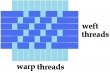
A twill is a basic weave based on a unit of three or more individual warp threads (picks) and three or more individual weft threads (ends). In this type of weave, each end passes over two or more adjacent picks and under the next one or more. The binding points move one end on successive picks and form characteristic diagonal lines. There are many forms of twill weave.

Story quilt is a term used to describe a quilt, usually with appliqué details, which provides pictorial images that portray some episode of the quilter’s individual or family history. This type of quilt is usually associated with other types of African-American quilts.

This is an embroidered picture of a shepherdess worked by Esther Stoddard (1738-1816; Northampton, New England, USA) in c. 1750-1760. The image is of a reclining shepherdess in a wooded landscape with a spotted dog, woolly sheep, lambs, a leaping deer, blackbirds, a peasant and a small pond with ducks. In the background there is a two storey house with two chimneys.
Stitching is a term sometimes used in decorative needlework for the application of the back stitch.

The sharp needle (or 'sharp') is a type of needle used for general hand sewing, including decorative needlework. The sharp needle has a sharp point, rounded eye and is of medium length (generally between 4 and 5 cm). It is sometimes also called an appliqué needle.

Satin weave is a basic weave form based on a unit of five or more individual warp threads (ends). In this weave, each end passes over four or more adjacent weft threads (picks) and under the next one.
More...

Satin cloth is a type of woven material that has a glossy surface and a dull reverse. This effect is achieved through a satin weave.
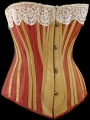
Sateen weave is a basic weave form based on a unit of five or more individual weft threads (picks). Each pick passes over four or more adjacent warp threads (ends) and under the next one.

William Rutlish (also written Ruthick) was a King’s Embroiderer at the court of Charles II of England (r: 1660-1685). He was buried in St. Mary’s Churchyard, parish of Merton (SW19), London.

Ruskin lace is a form of embroidered lace that combines cutwork, drawn thread work and embroidered lace. The technique was supported by the English art critic and patron, John Ruskin (1819-1900), from the 1880's onwards.