

Indigo (Indigofera species) is a tropical plant of the genus Indigofera, which is a commercially important source of the blue dye stuff, indigotine. The most important indigo plant form is Indigofera tinctoria (also known as Indigofera sumatrana).

Hawaiian quilts represent an appliqué and quilting style that was developed by indigenous Hawaiians. It may reflect older kapa (bark cloth) traditions. Hawaiian quilts characteristically have a central design that is cut out of a piece of cloth that has been folded into halves, quarters or eighths. The thus created radiating design it is stitched onto the white top cloth of the quilt, with echo quilting around the cloth's edges.

Edmund Harrison was the King’s Embroidererat the courts of James I (r: 1603-1625), Charles I (r: 1625-1649) and Charles II (r: 1660-1685) of England. Harrison grew up in London, but nothing is known of his apprenticeship as an embroiderer. His name is associated with William Broderick (d. 1620), King's Embroiderer to James I, and his son-in-law, John Shepley (Shipley; d. 1631), embroiderer to Charles I as Prince of Wales.

George Pinckney (also written Pinkney) was the King’s Embroiderer after the restoration of Charles II (r: 1660-1685) to the English throne. Pinckney was given the post of embroiderer in 1660/1, a position he shared with William Rutlish and Edmund Harrison. They were succeeded by J. Moseley (1680).
More...

Gee's Bend quilts are a particular type of patchwork quilt noted for their striking colours, asymmetry and geometrical shapes. The quilts are produced by women living in Gee’s Bend and by the freedom quilting bee in nearby Rehoboth (Alabama, USA).

Elizabeth Fry (née Gurney) was a social reformer, who is most noted for her work in prisons. She was born in Norwich, England, into a Quaker family. In 1799 she married Joseph Fry (1777-1861), a banker in London, with whom she had eleven children. Elizabeth Fry became a Quaker minister in 1810.
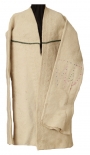
Fabric is a general term for any manufactured cloth-like material, produced through weaving, crocheting, knitting, etc., made for use in clothing, coverings, hangings, etc.