

An Amish quilt is a style of quilt developed in Amish communities in the USA. The Amish (sometimes called the Pennsylvania Dutch), are a group of Anabaptist Christians whose ancestors immigrated into the USA in the early eighteenth century. They are now concentrated in eastern Pennsylvania, Indiana and Ohio (USA).

The ‘Underground Railroad’ was a network of anti-slavery supporters in the USA and Canada, who operated safe houses for African-American slaves. It was in operation from the beginning of the nineteenth century and was at its peak of activity between 1859 and 1860. While there is no documentary evidence, in the popular American imagination quilts were used to identify safe houses on the Underground Railroad.
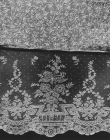
Tambour embroidery or tambour work is a technique whereby a chain stitch is worked with a fine hook (a tambour hook) on a fine, slightly open-weave cloth that is stretched over a frame. This type of work may have originated in India, where it is known as ari work or ari embroidery. For tensioning, sometimes a circular frame is used.

The Sistine Chapel Embroidery is a miniature replica of Michelangelo’s ceiling in the Sistine Chapel, Vatican, executed in cross stitch embroidery, worked between 1996 and 2004 by the Canadian, Joanna Lopianowski-Roberts (from San Francisco, USA)

Shadow work is a form of embroidery worked on the back of sheer or semi-sheer cloth. The thread, or rather its shadow, shows through to the front of the cloth. The main stitch used for shadow work is closed herringbone stitch, which forms a layer of criss-crossing threads. On the front of the cloth the embroidery has the appearance of back stitches.

The running stitch is the simplest of all the embroidery stitches. The needle ‘runs’ along the ground material, making stitches of more or less equal length and picking up only one to two threads of the ground material in between two stitches. Normally there is more thread visible on the surface of the cloth than on the underside. The running stitch is often used for outlining and as a foundation for other, composite stitches.

Roumanian stitch, also known as the antique stitch, Indian filling stitch, Janina stitch, or Oriental stitch, is a name used for a technique whereby a long stitch is tied down in the centre by one, short slanting stitch. The Roumanian stitch should be differentiated from Roumanian couching, which uses multiple tying down stitches to 'couch' a long, laid thread.
More...

Roumanian couching is an embroidery technique whereby the laid thread is fastened down by two or more stitches set at an angle. The laid thread is carried across the space from left to right and is then fastened down by the same thread on its return journey with stitches at regular intervals. The Roumanian stitch is very similar, but much shorter and has only one stitch set at an angle to fasten down the laid thread.

Harriet Powers was an African-American quilter, who was born into slavery in Clarke County, Georgia (USA). She is famous for her two surviving story quilts. Both items are made of cotton and use appliqué to create pictures.