
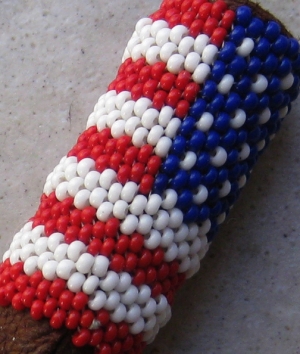
The Peyote stitch is an off-loom beading technique, the result of which is sometimes known as Peyote work. It can be worked with either an even or odd number of beads per row.
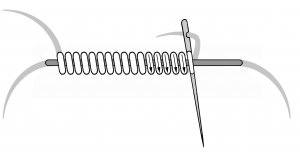
Overcast couching is a form of couching, in which a trail of foundation threads is placed on a linear design drawn on the ground material. Then small overcast stitches (straight) or satin stitches (slanting) are worked over the foundation threads and through the ground material. The aim is to totally cover the foundation threads. This technique produces a firm, raised line that is useful for scroll patterns, plant stems and so forth.
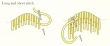
The long and short stitch is a form of free style embroidery, often used for shading flower petals and bird feathers. The characteristic feature of this stitch is that the stitches of the first row are worked in such a way that they are alternately long and short. The stitches in the ensuing rows are all of the same length and fit into the first row.
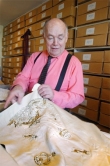
François Lesage was a French embroidery designer and director of the embroidery atelier of Maison Lesage, Paris. Lesage had the nickname 'Mr Buttons'. He was born in Chaville, France, on 31 March 1929, the son of Albert Lesage and Marie-Louise Favot (a model working for the famous fashion designer, Madeleine Vionnet). He inherited the Maison Lesage from his father in 1949.
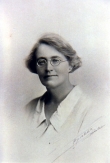
Grace Mary Crowfoot was an English scholar who published numerous articles and books about European and Middle Eastern textiles and textile production. She is regarded as one of the Grandes Dames of the study of archaeological textiles.

The Creation Altar Piece is a South African stitched and beadwork embroidery, inspired by the altar piece 'The Lamb of God' (Het Lam Gods), painted by the Flemish artists, Hubert and Jan Van Eyck (Gent, Belgium, early fifteenth century). The Creation Altar Piece was made by the Hamburg Women’s Co-operative (Hamburg is a rural area of the Eastern Cape, South Africa) under the auspices of the Keiskamma Trust.


Brodeuses is a 2004 French film directed by Éléonore Faucher. It is known as A Common Thread in Britain and Sequins in the United States. The film is about a young French girl who becomes an assistant in an embroidery atelier. The plot revolves around this girl, called Claire (played by Lola Naymark), who lives by herself as she does not get along with her parents.

The back stitch belongs to a class of individual stitches that are made backwards to the general direction of sewing. Back stitches are normally worked from right to left. The needle is brought out a short distance from the beginning of the line to be covered. It is then inserted again at the beginning of the line, thus taking a step backwards. The needle emerges beyond the point where it first started.
More...

African-American quilts are a form of decorated soft furnishing made in the nineteenth century and later. The quilters often employ techniques such as appliqué and patchwork, with narrow bands of cloth sewn together in strips (string quilting), in strong, contrasting colours.

Luneville embroidery is an umbrella term for various types of tambour embroidery, originating from the French town of Lunéville (Lorraine, France), where in the late eighteenth century a number of embroiderers had settled. Around 1810 they invented a form of tambour embroidery, using a very fine tulle cloth, which was decorated with chain stitch. Luneville embroidery may thus be classed as a form of embroidered net lace.
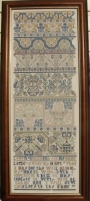
The Loara Standish sampler is the oldest known extant sampler in the USA, and was worked probably in the 1640's. The sampler is embroidered on fine linen (c. twenty threads per cm) using blue, green, pink and red silk thread. It is 60 x 18.5 cm in size. The stitches used include: Algerian eyelet stitch, back stitch, double running stitch, long-armed stitch and Montenegrin cross stitch.

Lier (Lierre) lace is a form of embroidered net lace produced in the nineteenth and twentieth centuries in the northern Belgian town of Lier. One story says that around 1825, a Mr. Timmermans married Miss De Keersmaeker, who ran a lace school in Lier. Together they developed a form of embroidered lace that used a tambour hook rather than a needle to decorate cotton bobbinet.