
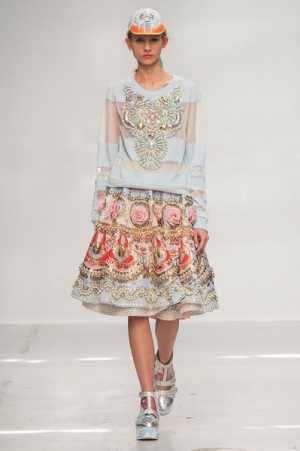
The Victoria and Albert Museum in London houses a woman's skirt and top designed by the Indian designer, Manish Arora. The garments date to 2014-2015. They are heavily decorated with appliqué, embroidery, and crystal beads and sequins.

Manish Arora, born in Mumbai in 1972, is one of India's leading fashion designers. He trained at the National Institute of Fashion Technology, New Delhi, where he graduated in 1994. He launched his own fashion label ('Manish Arora') in 1997. He showed his creations at the London Fashion Week in 2005, and at the Paris Fashion Week in 2007.

The Victoria and Albert Museum in London houses a pair of wool embroidered half-boots (also called ankle boots), which date to the mid-nineteenth century and were made in Britain. They are made of canvas, with elastic side gussets, and with the uppers being (hand) embroidered. The boots measure 18 x 10 x 28 cm.
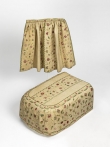
The Victoria and Albert Museum in London holds an early eighteenth century quilted and embroidered cot set (cot cover and two curtains, sewn together at a later date), made in England. The textiles are flat quilted (without wadding), using a back stitch with silk thread. The textiles are made of linen and lined with cotton. The cot cover measures 93 x 60 x 90 cm.
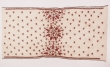
The British Museum in London houses a wedding shawl (abochhini) from the Thar desert or beyond, in southern Pakistan. It is made of cotton and decorated with silk thread embroidery (chain stitch) and shisha work. The shawl measures 255 x 135 cm. The object was acquired in 1984.

The British Museum in London houses a large rectangular shawl from Gujarat, western India. It is made of black silk and is embroidered with chain stitch, showing alternate bands of white-petalled and crimson-petalled flowers. In the centre is a densely embroidered star-shaped motif with shisha work. The shawl is edged with bands of crimson satin. The shawl measures 195 x 170 cm.

The British Museum in London houses a woman's waistband for a skirt, which is made of cotton and is decorated with embroidery. It is attributed to Banjaras from central India. The waistband measures 95 by 35 cm. The object was acquired in 1993.
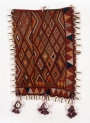
The British Museum in London houses a woman's neck cover that is made of cotton and decorated with embroidery (long and short stitch), cowrie shells and pompoms made of silk. It is attributed to Banjaras from central India. The neck cover measures 30 by 23 cm. The object was acquired in 1991.

The British Museum in London houses a bodice that is made of cotton and decorated with embroidery, coins and shisha work. It is attributed to Banjaras from Rajasthan, Western India. The bodice measures 60 by 63 cm. It dates to 1918 or earlier.

The British Museum in London houses a man's waistcoat that is made of cotton and decorated with embroidery, mainly with geometric motifs. It is attributed to Banjaras from Central India. The garment measures 75 by 24 cm (excl. shoulder straps). It dates to the early twentieth century or before.
More...

The British Museum in London houses a wedding mat that is made of cotton and decorated with embroidery, appliqué and shisha work. It is attributed to Banjaras from Central India. The mat measures 65 by 65 cm. It was acquired by the Museum in 1986.

The British Museum in London houses a dowry bag that is made of cotton and decorated with embroidery and shells. It is attributed to Banjaras from Central India. The bag measures 42 by 42 cm. The object was acquired in 1986.

The British Museum in London houses a skirt that is made of cotton and decorated with embroidery and shisha work. It is attributed to Banjaras from Rajasthan in India. It dates to 1918 or earlier. The skirt measures 90 by 50 cm.

The British Museum in London houses a container, made of cotton and decorated with embroidery. The container measures 57 by 56 cm. It is attributed to the Banjaras from India. The Museum acquired the object in 1986.