
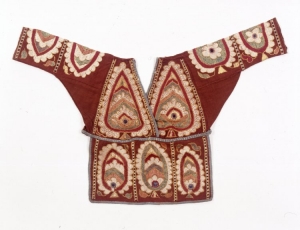
The British Museum in London houses a blouse, made of cotton and decorated with embroidery. The garment measures 41 by 71 cm. It is attributed to the Banjaras from Himachal Pradesh, India. The blouse was acquired by the Museum in 1993.
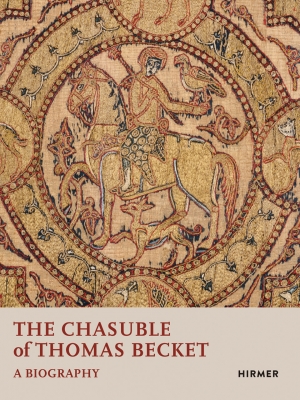
Fermo Cathedral in east central Italy houses a chasuble that reputedly belonged to St Thomas Becket, the English Bishop of Canterbury, who was murdered on 29 December 1170 and was canonised two years later, on 25 February 1173, by Pope Alexander III. The semicircular chasuble is 1.6 m high and has a circumference of 5.4 m. Its description as a chasuble is somewhat surprising, since its appearance is that of a cope.
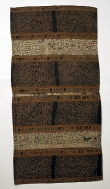
The Metropolitan Museum of Art in New York houses a sarong from Lampung, southern Sumatra, Indonesia. It probably dates to the early twentieth century. It is made of cotton (ikat) bands interspersed with silk thread embroidered bands. According to curatorial information, the combination of ikat and embroidery is characteristic for (central) Lampung.

The Metropolitan Museum of Art in New York houses a ceremonial banner from Lampung, southern Sumatra, Indonesia. It probably dates to the eighteenth century and measures 411.5 x 123.2 cm. It seems to be a palepai, the name for a large hanging that was displayed by the wealthy on important occasions. Such hangings often carried representations of large ships.
The Metropolitan Museum of Art in New York houses a ceremonial costume element with woven decoration and with beadwork. It derives from the island of Timor, in the modern province of East Nusa Tenggara, Indonesia, and dates to the late nineteenth or early twentieth century. It is 44.45 cm wide and made of cotton.
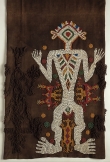
The Metropolitan Museum of Art in New York houses a ceremonial woman's skirt (localled called lau hada) decorated with beadwork. It derives from the island of Sumba, in the modern province of East Nusa Tenggara, Indonesia, and dates to the early twentieth century. It measures 157.5 x 49.5 cm. It is made of cotton with a decoration made of nassa shells and glass beads.

The Metropolitan Museum of Art in New York houses a quilted fragment of tent lining from eighteenth century India. It has a cotton back material and silk thread embroidery. It measures 170 x 142 cm. The embroidery shows the characteristic Mughal motif of a flowering plant in an arched niche.

The Metropolitan Museum of Art in New York houses a decorative pendant made of silk and metal thread embroidery on a silk satin back material. It measures 65 x 30.5 cm and has been dated to the early fifteenth century, in the Ming dynasty (1368-1644).

The Metropolitan Museum of Art in New York houses a hanging scroll with silk appliqué and embroidery on a silk back material. It measures 96 x 47 cm and has been dated to the Ming dynasty (1368-1644).

'The sacrifice of Polyxena' is the name given to a large hanging now in the Metropolitan Museum of Art, New York. It probably dates to the late sixteenth century, and was likely made in China (Macao?). It measures 381 x 523 cm and is made of a cotton ground material with silk and gilt paper wrapped embroidery thread (Japanese thread) and with painted decorations.
More...

'The prophecy of Calchas' is the name given to a large hanging now in the Metropolitan Museum of Art, New York. It probably dates to the late sixteenth century, and was likely made in China (Macao?). It measures 375 x 498 cm and is made of a cotton ground material with silk and gilt paper wrapped embroidery thread (Japanese thread) and with painted decorations.

'The abduction of Helen' is the name given to a large hanging now in the Metropolitan Museum of Art, New York. It probably dates to the early seventeenth century, and was likely made in China (Macau?). It measures 363 x 480 cm and is made of a cotton ground material with silk and gilt-paper wrapped embroidery thread (Japanese thread) and with painted decorations.

The Rijksmuseum in Amsterdam houses an early eighteenth century (high) valance (Dutch: lambrekijn), made of yellow silk cloth that was probably made and embroidered in China. The motifs include flowers and butterflies.

The Rijksmuseum in Amsterdam houses a nineteenth century quilt from India, made of cotton and embroidered with floral motifs, worked with a hook (ari) and chain stitch, using silk thread, and filled with cotton. The cloth measures 69.5 x 61.5 cm. The collection of the Rijksmuseum also has a series of comparable quilts.