
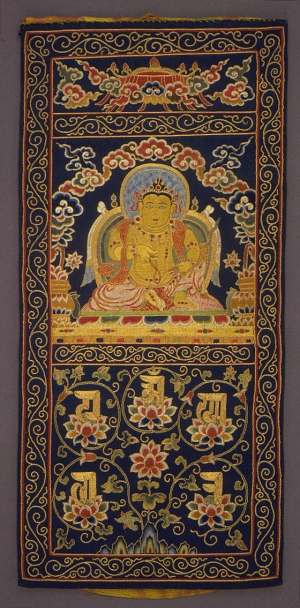
The Los Angeles County Museum of Art houses a votive panel from China, which dates to the early fifteenth century. It measures 40 x 18 cm. It is made of silk with silk and metal thread embroidery.
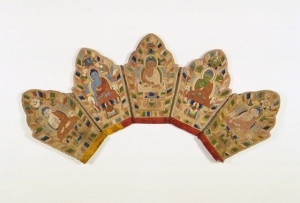
The Los Angeles County Museum of Art houses a ritual diadem (guan) from China, which dates to the late fifteenth century. It is made of gilded paper with silk embroidery. It measures 29 x 58 cm.
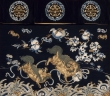
The Los Angeles County Museum of Art houses a table frontal from China, which dates to the early nineteenth century. It measures 83.2 x 95.3 cm. It is made of silk satin with silk and metal thread embroidery and bast fibre lining.

The Los Angeles County Museum of Art houses a badge (lizi) of the imperial prince, with dragon. It dates to the early seventeenth century and is made of silk satin with silk and metal thread embroidery. It is 30 cm in diameter.
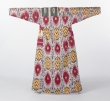
The Los Angeles County Museum of Art houses a woman's robe (munisak) from Uzbekistan, dating to about c. 1875. It is 117 cm long and has a bottom width of 159 cm. It is made of silk and a cotton resist-dye warp thread (ikat). It is furthermore decorated with silk thread embroidery.
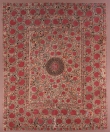
The Los Angeles County Museum of Art houses a large suzani hanging or curtain from the third quarter of the nineteenth century. It measures 211 x 173 cm. It is made of a linen ground material with silk and wool thread embroidery.

Mrs Mary Delany (1700-1788), née Granville, was an accomplished embroideress, designer and artist (her paper cuttings were famous), and writer, who commented in her extensive and extant correspondence on the garments and their cut and decoration, of the men and woman of her social circle.

The Victoria and Albert Museum in London houses a mid-nineteenth century Kashmir man's cloak, made of extremely fine wool and embroidered with silk using running stitches. It measures 60 x 295 cm. According to curatorial information, this cloak was made for the European market.
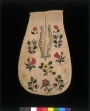
The Victoria and Albert Museum in London houses an embroidered woman's pocket made in England in the early eighteenth century. It measures 34 x 21 cm. It is made of linen and embroidered with woollen thread.

The Victoria and Albert Museum in London houses a mid-nineteenth century woollen coat or choga richly decorated with gold-thread embroidery and couching. The choga was acquired in Amritsar in 1855.
More...


The Victoria and Albert Museum in London holds a sample of the famous chikan fabric. It was made in Lucknow at the beginning of the twentieth century and measures 40.1 x 30 cm. This sample includes two delicately embroidered bands or cuffs, which would be cut out to be sewn onto a garment. The pale brown embroidery threads are muga silk, often added to the chikan fabrics from Lucknow.

The Victoria and Albert Museum in London houses a dress measuring 101 x 111 cm. It was made in the late nineteenth century, and consists of a silk satin ground material with silk thread embroidery and shisha work. The embroidery was worked in buttonhole, chain stitch and interlacing stitch. Curatorial information suggests that the dress originates from the Muslim Memon or merchant community in Banni, Kutch.

The Victoria and Albert Museum in London houses a waistcoat measuring 76.2 x 38.1 cm. It was made in the mid-eighteenth century in India, perhaps for the European market, and consists of a cotton ground material with woollen thread embroidery.