

The Victoria and Albert Museum in London houses a piece of dress fabric measuring 220 x 106 cm. It was probably made in Gujarat, western India, in the early eighteenth century, and consists of a cotton ground material with silk thread embroidery. The designs include birds, flowers, fruit, but also architectural motifs and are worked in chain stitch. The designs are repeated twice for every width.

The convent of Wienhausen (Germany) houses three embroideries that illustrate the medieval legend of Tristan and Iseuld (Isolde). The oldest of the three dates to c. AD 1300. It measures 2.33 x 4.04 cm. It is embroidered in wool on a linen ground material, using the kloster stitch.

The Victoria and Albert Museum in London houses a remarkable embroidered picture, representing Charles I just before his execution on 30 January 1649, with his son, Charles II, standing to the left. The embroidery is worked in silk and metallic thread, with seed pearls, on a white satin ground. It measures 36.5 x 47.3 cm.
Reputedly the oldest extant example of Russian ecclesiastical embroidery is the so-called veil or shroud of Grand Princess Maria of Tver, from c. AD 1400.

In the mid-twentieth century, excavations were carried out in the basilica of Saint Denis, the grave church of the Merovingian kings of the Franks. In this church, now in a suburb of Paris, a large number of sarcophagi were discovered. No. 49, discovered in 1959, yielded, so it appeared, the remains of Queen Arnegundis (Aregund, Aregunda, Arnegund, Aregonda, Arnegonda), the wife of the Frankish king, Clotaire I.

The Victoria and Albert Museum in London houses a silk embroidered panel with a representation of the Christian martyr, St. Sebastian. It dates to the eighteenth or early nineteenth century. The red colour of the background (now faded) corresponds with the colour normally associated in the Roman Catholic Church with martyrdoms.
More...
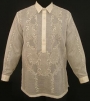
Piña is a fibre that is made from the leaves of the pineapple (Spanish: piña). It is especially used as such in the Philippines. Piña cloth was widely applied in the Philippines, especially for the barong tagalok, the embroidered shirt which is still being worn, especially for formal occasions.

The Rijksmuseum in Amsterdam houses a bed cover made of silk satin with floss silk and metal thread embroidery, which was made in China in the early eighteenth century. The cover measures 330 x 235 cm. The cover goes with two other items in the Museum's collection, namely a bed (acc. no. BK-1958-20-A) and a bed curtain (BK-1958-20-C).

The Rijksmuseum in Amsterdam houses a richly embroidered herald's tabard (Dutch: wapenrok) that was worn at the funeral of Prins Frederik Hendrik van Oranje Nassau (1584-1647), stadhouder of the Netherlands, in Delft on 10 May 1647. Four heralds were wearing such a tabard; a fifth was held up on a standard (see engraving). This is the only one still extant, and measures 90 x 120 cm.
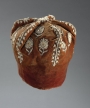
In 1675, the Spanish king, Charles II (1661-1700), presented the Dutch Admiral, Michiel Adriaansz. de Ruyter (1607-1676), with a ducal crown. The crown itself has been lost, but the tall, woollen hat that went inside the crown has been preserved, and is now housed in the Rijksmuseum, Amsterdam.