
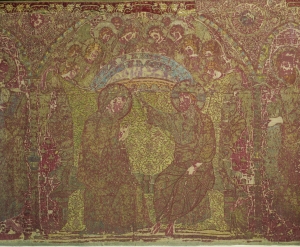
The Victoria and Albert Museum in London houses the so-called Veglia altar frontal, which was made in the early fourteenth century in Venice, Italy. It measures 107 x 277 cm. It is made of a red silk, with underside couching in metal and silk, and with coloured silk threads embroidered mainly with split stitch for the outlines and details.

Opus consutum is mentioned in thirteenth century documents and may be translated as 'sewn-together work'. It would refer to intarsia or inlaid appliqué. The term is again used from the late-nineteenth century for appliqué work, especially from the medieval period. The word is first attested by the Roman Catholic priest and ecclesiast, Daniel Rock (1799-1871).
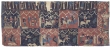
The Victoria and Albert Museum in London houses an (incomplete) appliqué wall hanging, popularly known as the Tristan hanging. It originates from North Germany and was made in the late fourteenth century. It is 109 cm high and 256.5 cm long. It is a dark blue, woollen cloth with appliqués of woollen fragments. It contains 22 scenes from the medieval Tristan and Iseuld (Isolde) legend.
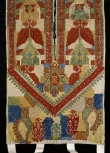
The Victoria and Albert Museum in London houses an embroidered bed tent door from the Dodekanesos, modern Greece. It dates to the eighteenth century. See also the entry on Greek bed tents.
An Embroidery Pattern Book was published in 1917. It was written by Mary E. Waring. It includes a foreword by W.R. Lethaby, Professor of Design at the Royal Colllege of Art, South Kensington. To download the book, in various formats, click here.
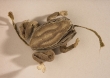
The Los Angeles County Museum of Art houses an English, frog-shaped needlecase from the early seventeenth century, made of silk with metal thread embroidery. It measures 4.45 x 5.1 cm. See also the entry on a needlecase with scissors, seventeenth century, now housed in the Victoria and Albert Museum, London.
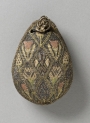
The Los Angeles County Museum of Art houses an English pomander purse from the early seventeenth century. It measures 10 x 7 x 3 cm. It is made of silk and decorated with silk and metal thread embroidery. See also the more extensive entry on the pomander purse in the British Royal collection.
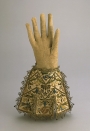
The Los Angeles County Museum of Art houses a pair of man's ceremonial gauntlets from England, dating to the early seventeenth century. They are made of leather, with silk and metal thread embroidery. They are 36 cm long.

The Victoria and Albert Museum in London houses a Daoist gown from China, dating to the seventeenth century. It is made of silk satin, and decorated with silk and gold threads. The gown is square in shape, without sleeves, and with a hole for the head.

The Victoria and Albert Museum in London houses a screen panel from Korea that dates to the nineteenth century. It is made of silk, with silk thread embroidery. The screen measures 59.2 x 32.2 cm. It forms part of a set of four. The decoration is formed by columns of flower arrangements, interspersed with Chinese characters, expressing long life and happiness.
More...
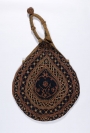
The Victoria and Albert Museum in London houses a cotton betel bag from Sri Lanka, which dates to the late nineteenth century. It is embroidered with floral and geometric motifs.

The Victoria and Albert Museum in London houses a headdress from the north of Pakistan (Chitral). It is made of a densely woven wool and felted cloth (locally called patti). It dates to the twentieth century. It is 83 cm high and 85 cm wide at the base.

The Victoria and Albert Museum in London houses a woman's shirt from Lahore, in what is now Pakistan. It is dated to the mid-nineteenth century. The shirt, locally called a kurta, is made of cotton with silk and metal thread embroidery, and sequins. It is 71 cm long and 156 cm across the sleeves.
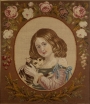
The Victoria and Albert Museum in London houses an embroidered picture representing a girld holding a cat. It dates to c. 1840 and was made in Britain. It is an example of Berlin wool work, with wool and silk on canvas, using chain stitch. The embroidery measures 76 x 69 cm.