
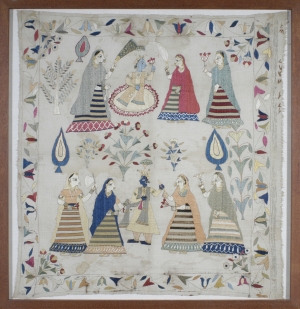
The Los Angeles County Museum of Art houses a chamba rumal from the late eighteenth or early nineteenth century. It originates from Himachal Pradesh, perhaps from Kangra, the traditional centre of the old principality of Chamba. The rumal (coverlet) measures 77 x 72 cm. It is made of cotton with silk thread embroidery and the decoration is reversible. It shows Krishna being adored by gopis (shepherdesses).
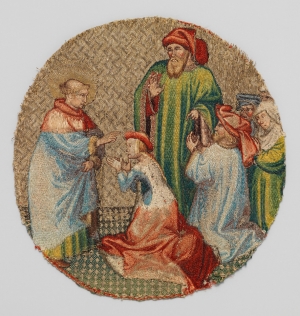
A roundel with a diameter of 15.5 cm with embroidery carried out in the or nué tradition, popular in the Netherlands in the fifteenth and sixteenth centuries, is housed, among other or nué examples, in the Metropolitan Museum of Art in New York. It dates to the early fifteenth century and shows two scenes from the medieval legendary story of Saint Martin. The embroidery is carried out in silk and silver thread on a linen background.
"Scenes from the Life of St. Martin: Franco-Flemish Embroidery from the Met Collection" was the name of a small exhibition organised in 2015 in the Metropolitan Museum of Art in New York. It showed some fifteenth-century embroideries with scenes from the life of Saint Martin, a fourth century Christian saint, carried out in the or nué technique.

“A World of Feathers” is the title of an exhibition at the Ethnographic Museum (Volkenkunde Museum) in Leiden (the Netherlands, click here), open to the public from 14th October 2016 until March 5th 2017.
SA wrote the following personal report:
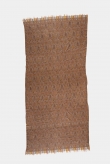
The Los Angeles County Museum of Art houses a Kashmir shawl from Kashmir, India, which dates to about 1825-1850. It measures 142 x 300 cm and is made of, and embroidered with wool.
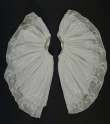
The Los Angeles County Museum of Art houses a pair of woman's engageantes. They were probably made in Britain, and date to the mid-eighteenth century. They measure 25 x 50 cm and are made of a plain weave cotton with cotton thread embroidery.

The Los Angeles County Museum of Art houses a long length of buratto embroidery from Italy, dating to the seventeenth century. It measures 5.46 x 0.6 m. It is made of silk embroidery upon a linen net. Buratto embroidery was often used as a border trim (hence the long length of this piece). The vase-and-niche motif and the bright colours recall Turkish influences.

The Los Angeles County Museum of Art houses a palampore from late seventeenth or early eighteenth century India, embroidered with a motif of a flowering tree (as with all traditional palampores). It measures 328 x 264 cm. It is made of cotton with silk thread embroidery worked with a chain stitch.

The Los Angeles County Museum of Art houses a cope that dates to the early eighteenth century and was made in Austria or neighbourling Bohemia. It measures 138 cm (length at the back) by 283 cm (width). It is made of a silk satin ground, decorated with silk applique, silk and metal thread embroidery, passementerie and tassels, and metal thread wrapped toggles.

The Los Angeles County Museum of Art houses a hanging showing Shakyamuni Buddha and the eighteen arhats. It measures 105 x 75 cm and dates to the nineteenth century and derives from eastern Tibet. It is made of silk with silk thread embroidery.
More...

The Los Angeles County Museum of Art houses a man's robe from Uzbekistan. It measures 134 cm (centre back length) and dates to the late nineteenth century. It is made of cotton with metal thread embroidery and a velvet trim. The lining is also made of silk, with resist dyed warps (ikat).
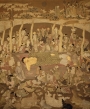
The Los Angeles County Museum of Art houses a Japanese embroidery showing the death of the Buddha (parinirvana). It measures 214 x 176 cm and was completed at the end of the eighteenth century. The wall hanging is made of silk with silk and metal thread embroidery.
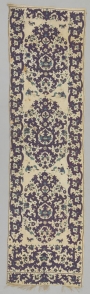
The Textile Museum of Canada holds an embroidered curtain from Algeria. It dates to the nineteenth century and measures 188 x 50 cm. It is made of linen with purple-coloured silk embroidery. The embroidery was carried out on a wooden frame, using herringbone and satin stitches, and couching.
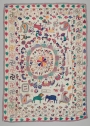
The Textile Museum of Canada holds a kantha embroidery from West Bengal in India. It was made by Srimirthi (Mrs.) Lokhibala Dashi sometime between 1920 and 1960. It measures 184 x 128 cm and is made of cotton. These kanthas were made of pieces of old clothing, sewn together, and embroidered with running and darning stitches, often with a lotus motif in the centre.