

Surayia Rahman (1932-2018) was an artist, designer and kantha-maker from Bangladesh who initially painted pictures and designed dolls, but later promoted the development of kanthas, traditionally made for private use, into an art form for public display. A documentary film about her life and work is entitled Threads: The Art and Life of Surayia Rahman, directed by Cathy Stevulak (first shown in 2016).
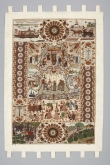
The Textile Museum of Canada, Toronto, Canada, houses a modern, silken nakshi kantha embroidery, called Georgian Times. It measures 158 x 108 cm. It was designed by Surayia Rahman in Bangladesh, in 2003. It is illustrated with scenes showing British soldiers in contact with local men and women in India. It has been described as a representation of an idyllic time before independence and chaos.
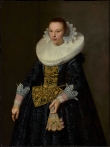
The J. Paul Getty Museum, Los Angeles, USA, holds a portrait of a young bride, painted by the Dutch master, Nicolaes Eliasz. Pickenoy (c. 1590 - 1654 or 1656). The portrait measures 118.7 x 91.1 cm, and is part of a pair, next to Pickenoy's portrait of the young bride's husband (see Getty Museum acc. no. 94.PB.1). The painting is dated to 1632. The bride was 21 years of age when painted.
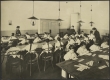
The J. Paul Getty Museum in Los Angeles, USA, holds a gelatin silver print from pre-revolutionary Russia, taken by Karl Karlovitz Bulla (1854? - 1929), showing an embroidery lesson. There is a teacher and two assistants, and the girls are working at different levels. The ones nearest to the teacher's desk are working on the more complicated items.

The National Museums Scotland houses a seventeenth century panel embroidered with various scenes, including King Solomon welcoming the Queen of Sheba, and the Dream of Jacob.

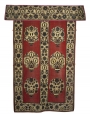
The National Museums Scotland holds an embroidered wall hanging that allegedly used to decorate the bed of Mary Queen of Scots at Loch Leven Castle, Kinross-shire, Scotland. It is made of red wool with a napped surface (creating a felt-like surface) and decorated with black velvet appliqué and silk thread embroidery.
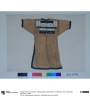
The Ethnologisches Museum in Berlin holds a drawing of an embroidered, Japanese bast fibre tunic. The drawing was collected by Philipp Franz von Siebold (1796-1866). It shows the type of tunic, worn by the Ainu, discussed elsewhere in TRC Needles. The German physician Von Siebold worked for the Dutch government at Deshima between 1823 and 1829, and settled in Leiden, The Netherlands, upon his return from Asia.
More...
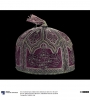
The Ethnologisches Museum in Berlin holds a dervish cap from Tabriz, Iran. It has a circumference of 56 cm and is 14 cm high. It is made of silk, wool and metal thread. The main embroidery parts are worked in chain stitch. It dates to the early twentieth century or before.
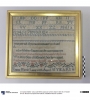
The Ethnologisches Museum in Berlin houses a sampler from Britain, completed in 1861 by Emma Marsh Langwith, who at the time was ten years old. The embroidery is worked in cross stitch, and the sampler measures 31.3 x 24.3 cm.
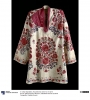
The Ethnologisches Museum in Berlin houses an embroidered woman's shirt from Yarkand, Xinjiang, in the most western part of China. It dates to the late nineteenth or early twentieth centuries, and was acquired during the Second Turfan Expedition (1904-1907), led by Albert von Le Coq (1860-1930). The fabric is made of cotton. The embroidery is worked with silk. The tunic measures 123 x 208 cm.
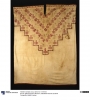
The Ethnologisches Museum in Berlin houses a man's shirt from Peru. It dates to the second half of the nineteenth century, or earlier, and was acquired by the German textile merchant and collector, Christian Theodor Wilhelm Gretzer (1847-1936). The fabric is made of cotton. The tunic measures 90 x 72 cm. The embroidery is worked with silk, using cross stitch.