
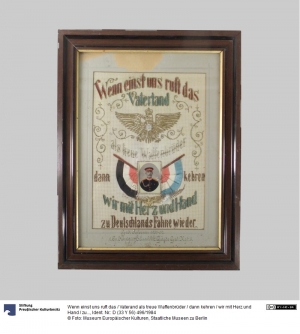
The Ethnologisches Museum in Berlin houses an embroidered commemorative panel, issued to a German officer who left active service to become a reserve officer. The panel measures 49 x 36 cm. The machine embroidered texts are worked in wool, chenille and gold and silver thread.
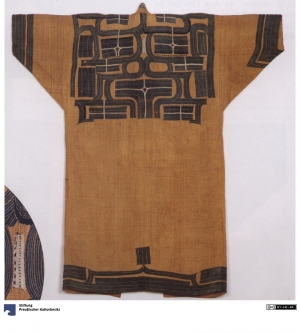
The Ethnologisches Museum in Berlin houses a bast fibre tunic from among the Ainu in Hokkaido, Japan. It dates to the second half of the nineteenth century, or earlier, and was acquired by Max August Scipio von Brandt (1835-1920). The fabric is made of the bast of the Atsui tree. The tunic measures 123 x 115.6 cm. The embroidery is worked with cotton.
The Ethnologisches Museum in Berlin houses a pair of early eighteenth century mitts, which were made in Germany. They measure 31.5 x 10 cm. The gold thread embroidery is partly worked free-style and partly worked over a card template.
The Ethnologisches Museum in Berlin houses a cotton horse blanket (chabrak), acquired c. 1900 by Willi Rickmer Rickmers (1873-1965). It is decorated with embroidery and paillettes.
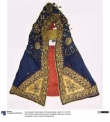
The Ethnologisches Museum in Berlin holds a silk and gold and silver thread embroidered woman's cape from what is now Ethiopia. It appears to be one of a number of comparable capes commissioned by the Ethiopian emperor, Tewodros II (c. 1818-1868), from the Adwa workshops, as part of his overtures to Queen Victoria for the modernisation of the country and defence against the Muslim neighbouring states.
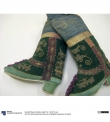
The Ethnologisches Museum in Berlin holds a pair of embroidered boots from Yarkand, Xinjiang, in the western parts of China. The boots were collected by the British explorer Robert Barkley Shaw in c. 1869. The embroidery is worked with metal thread and cotton thread. Some of the decoration is worked with chain stitch. The boots measure 40 x 24 cm.

The Ethnologisches Museum in Berlin holds a bison hide with some simple embroidery. The hide measures 271 x 218 cm. It was acquired c. 1832-1834 by the German explorer, Maximilian zu Wied-Neuwied (1782-1867), from the Gros Ventre region (North Central Montana) in the (modern) USA.

The Ethnologisches Museum in Berlin holds a pair of embroidered puttees (leg bands) from among the Hazaras in Afghanistan. The embroidery includes metal thread. The bands measure c. 44 x 9 cm. They were bought in Kabul in 1971/1972. See also Hazara embroidery.
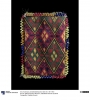
The Ethnologisches Museum in Berlin holds an embroidered prayer stone bag from Afghanistan, probably from among the Hazaras. Such a small bag is used to protect the prayer stone of the Shi'ite muslims. Such a bag is localled known as a kiseh-ye mohre namaz. It measures 10 x 7.2 cm.

The Ethnologisches Museum in Berlin holds an embroidered protective prayer cloth from Afghanistan, used to cover the clay tablet that Shi'ite muslims apply for their three-times per day prayer. It measures 21.5 x 21.5 cm and is made of cotton with silk thread embroidery.
More...
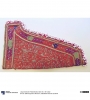
The Ethnologisches Museum in Berlin houses an embroidered holster for a handgun. It measures 24 x 15 cm and is made of cotton with multi-coloured embroidery, gold thread and applied pearls. One of the techniques used is the chain stitch.
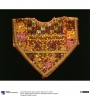
The Ethnologisches Museum in Berlin houses an embroidered children's bib from among the Ensari Turkmen in Afghanistan. It measures 40 x 37 cm and is made of cotton with silk thread embroidery.
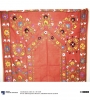
The Ethnologisches Museum in Berlin has an embroidered prayer mat from Afghanistan. It measures 149 x 103 cm and is made of cotton.
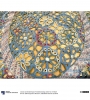
The Ethnologisches Museum in Berlin houses some cutwork curtains from Afghanistan, which were collected by Oskar von Niedermayer (1885-1948) when he was sent to Afghanistan by the German government to set up the Afghans against the British in India, during the First World War (1914-1918). The mission failed, and the German mission was forced to leave the country.