
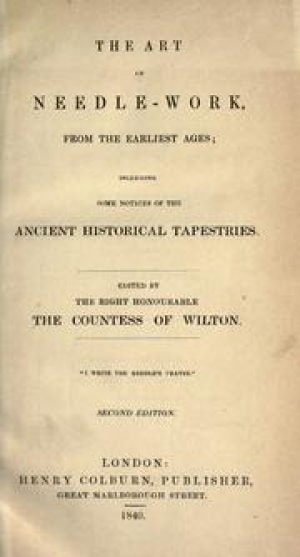
The Art of Needlework, from the Earliest Ages; including some notices of the ancient historical tapestries was first published in 1840. It was edited by Mary Margaret Egerton (1801-1858), Countess of Wilton, and published by Henry Colburn.

'Washington Square' is a short novel by the American author Henry James (1843-1916), in which embroidery (also called 'fancy-work') plays a major role. Henry James published the novel in serial form in 1880, in Cornhill Magazine and Harper's New Monthly Magazine.
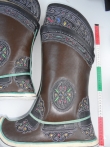
The Textile Research Centre in Leiden houses a pair of embroidered boots from Mongolia. They were acquired in 2008. They are made of felt, leather, vegetable and synthetic fibre. They are 53 cm high and 32 cm long.
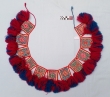
The Textile Research Centre in Leiden houses a machine woven waistband from Mexico, 54 cm in diameter, which is embroidered in cross stitch, and further embellished with red and blue tassels. It belongs to the ethnic group of the Huichol, in the west of the country.
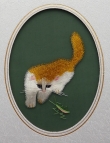
The collection of the Textile Research Centre in Leiden includes a double sided embroidery of a cat, from late twentieth century China. The embroidery measures 23 x 17 cm. The embroidery itself is made of silk and worked with a random, filling stitch, and is placed inside a protective cover. The cat is playing with a praying mantis.
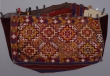
The Textile Research Centre in Leiden houses a yurt bag from the Uzbeks in Afghanisan, dating to the mid-twentieth century. It measures 80 x 38 x 24 cm. It is made of a cotton ground material with silk embroidery.

The collection of the Textile Research Centre in Leiden includes a sampler, 36 x 35 cm, which is made of cotton and embroidered with perlé thread. The central motif is a bunch of stylised flowers. In addition, there are the initials P and B and the date, 1904.

The collection of the Textile Research Centre in Leiden includes a cloth, 70 x 63 cm, which is made of cotton and embroidered with simple scenes taken from daily life. It dates to the 1930's and originates from Surinam in South America.

The Textile Research Centre in Leiden houses a jacket from Bethlehem, which dates to the 1920's and is made of factory-made velvet and decorated with hand embroidered couching showing stylised flowers and geometric motifs.
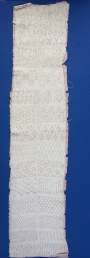
The Textile Research Centre in Leiden houses a remarkable knitting sampler (in Dutch called a breirol), which may be one of the oldest extant examples in Europe. It is dated to AD 1791 and was acquired together with a large group of Hungarian embroideries.
More...

Doris Langley (-Levy) Moore was an important British fashion historian. She founded the Museum of Costume in 1963, which since has been renamed the Fashion Museum, in Bath. She was also an expert on Lord Byron, and in the 1940's wrote the scenario for a ballet, The Quest.

The Textile Research Centre in Leiden has a protective prayer cloth from Afghanistan (TRC 2007.1132). It measures 29.5 x 29 cm. It is made of cotton with silk thread embroidery. The techniques used are satin stitch and double running stitch.

The Nederlands Openluchtmuseum in Arnhem, Gelderland, the Netherlands, houses an embroidered hearth screen, somewhat in Biedermeier-style, which was used in the summer to hide the place where during the winter the hearth would be lit. The screen was made on the occasion of the marriage between Dirk Bezemer (1867-1938) and Dirkje Nolman (1869-1938) on 5 August 1891 in Delft, the Netherlands.

The Museum Het Valkhof in Nijmegen, Gelderland, the Netherlands, houses an embroidered cushion from the town of Nijmegen, Gelderland, which was used to present the keys of the town to Louis Napoleon (1778-1846) when he visited the place on 24 July 1808. The keys were presented by the Nijmegen mayor, J.E. Sanders van Well (1739-1814).