

The Textile Research Centre houses a Turkish postage stamp, dated 1994, with a representation of an embroidery used for a Paçalik dress (acc. no. TRC 2016.0290a). This dress was worn by the bride on the day after her wedding. Paçalik was also the name for the embroidery sewn onto a woman's underpants.

The National Museum of Iceland in Reykjavik houses a large number of embroideries, the oldest of which date to the thirteenth or fourteenth centuries. The extant medieval embroideries formed part of ecclesiastical garments and other textiles. These include altar frontals, burses and chasubles. From later centuries there are also embroideries used for secular purposes.
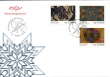
In 2008, the postal service of Iceland issued a series of three postage stamps with representations of Icelandic embroidery taken from the National Museum of Iceland in Reykjavik. The Textile Research Centre, Leiden, The Netherlands, holds a first-day cover with these stamps (acc. no. TRC 2016.0286).
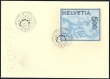
In the year 2000, the Swiss postal service issued a machine embroidered stamp to commemorate the St Gallen embroidery industry. This was the first postage stamp that was actually made as a form of embroidery. The stamp is attached to a first-day cover and housed in the collection of the Textile Research Centre, Leiden, The Netherlands.
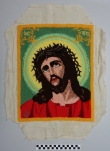
A representation of Christ with the Crown of Thorns, and worked in punch needle work, localled called igolochky, and measuring 60 x 47 cm, is housed in the collection of the Textile Research Centre, Leiden, the Netherlands (acc. no. TRC 2015.0554). It is made out of cotton and dates to the 1980's.
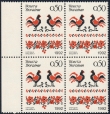
In 1992, Ukraine issued a series of postage stamps with a representation of folk embroidery. The stamps now form part of the collection of the Textile Research Centre in Leiden, the Netherlands (acc. no. TRC 2016.0289). The stamps bear an identical representation of two confronting chicken or cockrels and a floral motif, worked in black and red on a white ground.
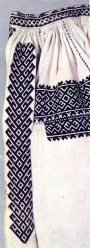
Nyz' embroidery derives from the eastern part of the Podillya region of the Ukraine (southwestern Ukraine and parts of Moldava). It derives its name (meaning 'below') from the way the embroidery is worked, namely on the reverse side of the cloth working in straight lines.
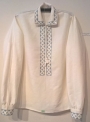
Reshetylivka is located in Poltava, in the centre of Ukraine, and has long been a centre of traditional hand made embroidery. As with other embroidery forms from central and eastern Ukraine, the colours of the local embroidery are subtle, with black-on-white, blue-on-white and grey-on-white colour schemes being particularly popular. Pulled thread work is also being created. An important motif is that of the Tree of Life.

Nyzynka embroidery from the Ukraine is named after its technique of working the basic pattern from the reverse of the cloth. It is closely related to Nyz' embroidery from the southwest of the country; Nyzynka work is especially known from among the Hutsuls along the Ukrainian/Romanian borders.
More...

The weaving stitch is also known as the Queen Anne stitch or the woven filling stitch, and is a form of darning stitch, which can be used instead of a satin stitch. Stitches are made in horizontal or vertical, parallel lines. Then other stitches are made vertically or horizontally, weaving through the horizontal/vertical stitches at a straight angle.
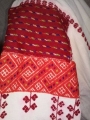
Ukrainian women have been working embroidery for centuries. The country harbours various traditions, some of them closely linked to embroideries of Russia further to the east and north; others more linked to East and Southeast European embroideries.

Krestetsky embroidery originates from the Krestetsky district, in the Novgorod Oblast, between St Petersburg and Moscow. This form of embroidery has over the years become famous in Russia and beyond. It is sometimes described as Krestetsky whitework, or Krestetsky flaxen work. It may be classed as a form of embroidered lace.