

The Royal Textile Academy of Bhutan, also known as the Bhutan Textile Museum or the National Textile Museum, was established in 2001. It was set up to promote Bhutan's textile arts and to serve the interests of the weavers in order to preserve traditional textile patterns. The academy and museum want to become the centre for textile studies and research.
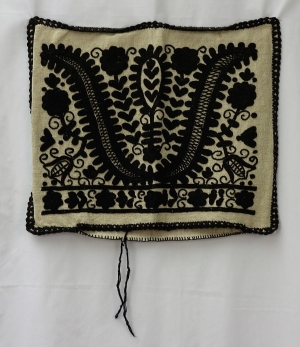
The Textile Research Centre (TRC), Leiden, houses an embroidered cushion cover from Hungary, which dates to the late twentieth century. It measures 48 x 41 cm. It is made from linen with cotton embroidery threads.
The Victoria and Albert Museum in London houses an embroidered picture from Finland, dating to the 1950's, that is made of jute and embroidered with silk and metal threads with running stitch and stem stitches and couching. The embroidery measures 15.3 x 21 cm. The decoration represents a stag, dove, heart, tree and star.
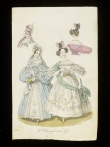
This fashion plate was published in St Petersburg in October 1834 and shows the latest (Parisian?) fashions in ladies wear, including a white ballgown with embroidered floral motifs on the skirt and sleeves.
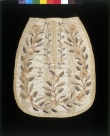
The collection of the Victoria and Albert Museum in London includes a pocket that dates to the early nineteenth century and was made in Russia. The ground material is made of linen and silk, sewn by hand with silk and linen, and embroidered with silk thread. It was acquired for the V&A in 1907, perhaps together with the towel end with bobbin lace.
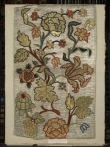
The Victoria and Albert Museum in London houses an embroidered panel from Russia, dating to c. 1700. It measures 71.2 x 43.2 cm. The ground material is made of silver thread and cotton, and the embroidery is worked in couched silver-gilt thread and chenille silks. The embroidery includes floral motifs and a bunch of grapes.

The Victoria and Albert Museum in London houses a border of a kerchief that derives from Russia and dates to the eighteenth century. It is made of green cotton decorated with motifs that are outlined in gilt thread and worked in satin stitch. There are embroidered floral motifs in red, pink, silver and green, and alternate panels of applied gilt embroidery, decorated with embroidered floral sprays.

A kustar is a Russian home or cottage worker, a peasant engaged in cottage industry. The kustar produced a wide range of products, including embroidery, and the popularity of kustar products can be regarded in the light of the arts and crafts revival of the nineteenth century.

The Victoria and Albert Museum in London houses a towel end that originates from Russia and dates to the nineteenth or early twentieth century. It measures 33 x 40 cm and is made of linen with bobbin lace in linen, silk and metal thread.

The Victoria and Albert Museum in London houses a valance (bed hanging) that dates back to the early eighteenth century. It is made of cream linen and is decorated with silk thread embroidery. The valance measures 103 x 41 cm. The embroidery is worked with pulled thread work and cross stitch.
More...

The Victoria and Albert Museum in London houses a woman's marriage coat from Siberia, which is made of sewn salmon skins. It was acquired by the museum in 1905, and information was added that it was a Gilyak coat from the lower Amur river region, near Vladivostok, from a tribe that was "dying out".
The Glascow Museums Resource Centre houses a sampler (acc. no. 1980.158) that was made by Margaret Sheddon and was completed in 1812. It was worked following the characteristic Scottish tradition of alternating designs in green and red silk on the ground material. The sampler measures 43.1 x 33.5 cm.

The Liaoning Provincial Museum (Chinese: trad. 遼寧省博物館, simp. 辽宁省博物馆, Liáoníngshěng Bówùguǎn) is located in Shenyang, Liaoning Province, China. It focuses on history and art. It was established under another name in 1949, and received its present appellation in 1959. It moved into its present new premises in 2003.