
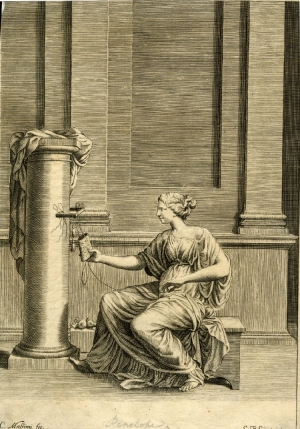
The British Museum, London, houses an engraving taken from the poem Documenti d'amore by Francesco da Barberino (1264-1348), which was published in Rome in 1640. The illustration shows a woman doing some sort of needlework, allegorically representing Industry.

Clementine Augusta, Marchioness Camden (née Spencer-Churchill; 1848-1886), is portrayed in this print that was published in the Whitehall Review in 1877. The Marchioness is shown being seated working a piece of needlework.
A photograph from c. 1850 shows a seated woman working what appears to be a narrow band of needlework. The photograph is housed in the British Museum, London. In pencil a text is added: Presented by the Earl of Ellesmere. The woman is believed to be the Earl's wife, Harriet Catherine, Countess of Ellesmere.
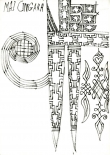
The British Museum, London, houses a series of design on A-4 size paper for embroidery on the front and back of a man's gown. They date to c. 2010 and were made in Kano, Nigeria.
The British Museum in London houses a goat's skull from among the Turkmen in Southwest Asia. It is covered with cotton cloth and embroidered with cotton threads. Embroidered goat's skulls seem often to occur with the Turkmen, and particularly with the Yomuts. The decoration includes black and pink floral designs, and multi-coloured plaited threads are wound around the horns. The eyes of the goat are also embroidered.
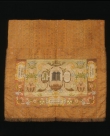
The Victoria and Albert Museum, London, houses an embroidered cloth that hang down the lectern (almemor, compare Arabic al minbar) in a synagogue. The cloth dates to the late seventeenth century and probably derives from Italy. It is made of linen and embroidered with silk and metal thread, and bordered with brocaded silk. The cloth measures 148.5 x 145 cm. Such a cloth is also known as a bimah cover.

A Japanese thread is a form of metal thread. There are two basic types. The first is made from gilded paper cut into long, narrow strips, which are normally couched down onto the ground material. The second form uses a similar strip of gilded paper, but this time it is wrapped around a fibre or thread core. Again, it is often couched down onto the ground fabric. Both forms have been used for hundreds of years.
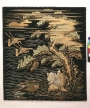
An embroidered and black velvet gift cover (fukusa) from Japan, dating to the mid-nineteenth century, is housed in the Victoria and Albert Museum, London. The embroidery is worked in silk and Japanese thread (gold-wrapped thread). The cover measures 76 x 67.1 cm.
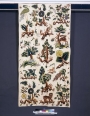
The Victoria and Albert Museum, London, houses a set of ten bed hangings made and decorated for a full-tester bed. They were made in England and date to the late seventeenth century and were embroidered in crewel work by Abigail Pett, whose name is added to one of the hangings.
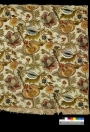
A fine example of Leek embroidery is held in the Victoria and Albert Museum, London. Leek embroidery, promoted by the Leek Embroidery Society, which was founded in 1879/1880 by Elizabeth Wardle, is characterised by embroidery being worked over a printed ground material.
More...

The British Museum, London, holds a long piece of embroidered cloth, some 6.5 by 1 m, which is described as a table cover or a floor mat, but which may be a kamarband, a traditional stretch of cloth wound around the waist. The ground material is cotton, and the embroidery is carried out in chain stitch with an ari hook, using silk thread.

A hat with upturned rim, acquired in Tibet in 1905, worn by a layman and dating to the late nineteenth and early twentieth centuries, is housed in the British Museum, London. The crown is made of overlapping blue and black silk, with polychrome floral silk embroidery.
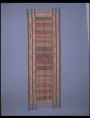
An embroidered hand cloth from Bhutan, localled called a chaksi pangkheb, dating to about 1900, is housed in the Victoria and Albert Museum, London. It is made of cotton with cotton and silk embroidery in darning stitch. This cloth was traditionally used for visitors to dry their hands. The cloth is almost 1.5 m long.
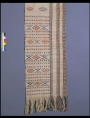
The Victoria and Albert Museum in London houses a lap cloth (localled called pangkheb) from Bhutan. It is made of unbleached cotton with woven and embroidered geometrical patterns in terracotta and indigo-coloured cotton threads. It is almost 2.5 m long. It dates to about 1900.