

The Victoria and Albert Museum in London houses a fragment of a tent panel from Qajar-period Iran. It is decorated partly in the typical Rasht-style (Rashti-duzi), named after an Iranian town north of the Elburz mountains close to the Caspian Sea. The panel is made of felted wool, embroidered with silk and metal thread and inlay patchwork (the latter being typical for Rasht work).
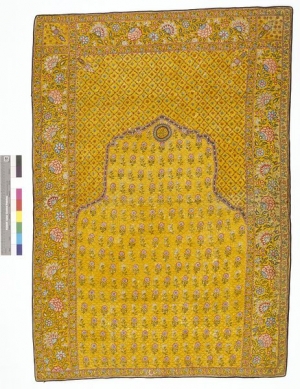
The collection of the Victoria and Albert Museum in London includes an Iranian, Qajar-period prayer mat. The mat measures 130 x 90 cm. The quilted mat has a yellow upper layer that is made of silk and cotton satin. It is decorated with silk thread using straight and running stitch (or back stitch?) and couching. The mat is padded and quilted with a cotton lining. The mat has a woven silk facing (edging).

In 1992, the French couturier, François Lesage, set up a school for embroidery, and each year some 400 students attend the courses being given.
Japanese Embroidery UK is the UK branch of the Japanese Embroidery Center (Georgia, USA), which itself is closely linked to the Kurenai kai organisation in Japan.
Iwao Saito was a Japanese master embroiderer, who founded the Kurenai kai organisation in Japan, set up in order to preserve and promote Japanese embroidery traditions. He published four volumes of The Japanese Embroidery Book (I, II, III and IV; from 1987), and Traditional Japanese Embroidery (1975; various titles; in Japanese).

Kurenai kai was established some forty years ago by the Japanese craftsman and author, Iwao Saito. He wanted to promote and hand down the long tradition of Japanese embroidery. The organisation wants to spread the technique and spirit of embroidery to the general public through workshops. The centre is located in Togane City, Chibu Prefecture, Japan.

The Japanese Embroidery Center, Kurenai-kai, Inc. is located in Atlanta, Georgia, USA, and was founded in 1989 by Shuji Tamura and his wife, Masa Tamura. It is a non-profit educational centre set up in order the promote traditional Japanese embroidery (nihon shishu), including beadwork.

The American Needlepoint Guild Inc. is an educational, non-profit organisation set up in 1972 to encourage educational and cultural development through participation in and encouragement of interest in the art of needlepoint. Needlepoint is defined by the Guild as any form of counted or free style stitchery worked by hand with a needle and thread on a countable ground.

The Miniature Needlework Society (International) was set up in 1997 to promote all forms of miniature needlework, including embroidery, crochet, tatting and lace making etc. The Society produces newsletters and organises workshops. It has attracted many members from Australia, Britain, the Netherlands and the United States.

The West Kingdom Needleworkers Guild of the Society for Creative Anachronism was set up in September 2000 in order to encourage, promote and study historical (medieval and Renaissance) needlework. The Guild Newsletter is called Filum Aureum and it contains a large number of articles written on various subjects by members and friends of the Guild (click here).
More...


The MGC (Mekong-Ganga Cooperation) Asian Traditional Textiles Museum is located in Siem Rap, Cambodia, and was opened in April 2014. It focuses on the textiles and textile production in and from Cambodia, India, Lao PDR, Myanmar, Thailand and Vietnam.

The Fine Arts G. Zanabazar Museum was established in 1966 and in 1995 named after the Buddhist teacher, G. Zanabazar (1635 - 1724). It is located along Juulchid Street in the Mongolian capital of Ulaanbaatar. It contains items that reflect the rich cultural history of Mongolia from earliest times until the beginning of the twentieth century.

The Museum Tekstil in Jakarta, Indonesia, was established in 1976 on the basis of a donation of some five hundred textiles by the Himpunan Wastrapema ('Society of Textile Friends'). The Museum's collection contains a wide range of warp and weft ikats, batiks, embroideries, beadwork, appliqués, tapestry weaves, and supplementary warp and weft textiles from all over Indonesia.