
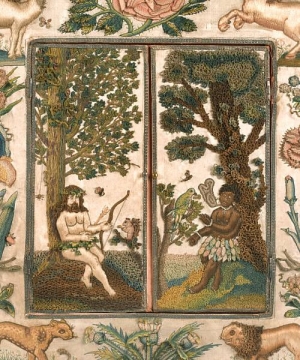
A needlework mirror with folding shutters was auctioned at Bonhams, London, in 2011. It dates to around 1660, was made in England and measures 38 x 35 cm. It is set in a tortoise shell and ebonised frame. The ground material is made of silk. The embroidery is worked in coloured silks and metal thread, using needlelace and other forms of needlework.

This cushion shows King Charles II and his wife, Queen Catherine of Braganza, together with allegories of the four continents (Africa, America, Asia and Europe). The cushion, now in the Metropolitan Museum of Art, New York, measures 20.3 x 80 x 68.6 cm. It was made after AD 1662, and embroidered in silk on a silk background, with beading.
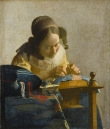
The Lacemaker (De Kantwerkster; La dentellière)) is a painting by the Dutch master, Johannes Vermeer (1632-1675), from about 1670. It measures 24.5 x 21 cm and since 1870 has been housed in the Musée du Louvre, Paris. The painting shows a young woman diligently at work on her piece of bobbin lace.

Hawthorne & Heaney is a company operating from a studio in London, specialising in the design and production of (hand) embroideries for a broad range of purposes, including haute couture and military. The firm was set up by Claire Barrett after she left the firm of Hand & Lock in 2011.
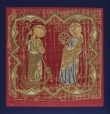
A fragment of a red silk velvet burse decorated in what is known as Opus Anglicanum is housed in the Victoria and Albert Museum, London. The panel measures 27.7 x 28.2 cm and is embroidered with silver and silver-gilt thread and silk. The V&A catalogue dates this panel to the years 1320-1340.
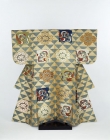
The Noh theatre in Japan was developed in the fourteenth century and reached its classical form some centuries later. It is marked by its austerity, understatement and frugality of expression. No actors were often wearing special garments called atsuita. These were worn under kariginu robes by the (male) actors. The decoration of the atsuita was often rather simple, since very little could be seen by the audience.

A fukusa is the name for a gift cover that traditionally was draped over a box that was placed on a tray. Inside the box was a gift. The selection of a particular fukusa was always very significant, both to the gift-giver as to the gift-receiver.
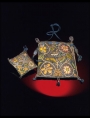
The Victoria and Albert Museum in London houses a remarkable pair of embroidered items from the early seventeenth century. They are a purse and a pin cushion. The purse measures 12,6 x 14 cm, and the pin cushion 7 x 7 cm. Both objects are decorated in a similar manner. The two objects, together with other early embroideries, were bequeathed to the Museum in 1954 by Sir Frederick Richmond.
John Nelham was an English embroidery draughtsman and materials supplier associated with the Broderers' Company in London.

Sir Frederick Henry Richmond was chairman of the department stores Debenhams and Harvey Nichol's, and made baronet in 1929. His son John Frederick Richmond (1924-2000) inherited the title, which became in fact extinct upon his death.
More...

Susannah and the Elders is the name given to an embroidered picture from England dating to around 1660 that is now housed in the Victoria and Albert Museum, London. It measures 46 x 56 cm. It is made of a silk satin background material embroidered with coloured silk threads and metal purl. The oval frame consists of parchment wrapped in silk.

The British Library houses a photograph of three embroiderers from Jammu and Kashmir in the northwest of the Indian subcontinent. The photograph was taken in the 1890's. The craftsmen are embroidering tablecloths, bed-spreads or other types of coverings, using a needle, rather than an ari hook. The designs include fruit, flowers, or other forms, including geometric patterns.

In the 1890's a group of three male embroiderers was photographed in the northwest of the Indian subcontinent, in modern Jammu and Kashmir. They are decorating floor coverings. The large covering in the centre is called a namdah and is being embroidered with an ari hook and a chain stitch.

The British Museum in London houses an embroidered, woollen boy's coat (92 x 158 cm) that originates from Chitral in the extreme north of Pakistan and was acquired in 1987. Coat is made of strips of densely woven and fulled wool, embroidered with woollen thread using chain stitch. Embroidered patterns recall patterns on Kashmir rugs.