

Peppier mache embroidery is a style of work carried out in the Jammu and Kashmir region of the northwestern Indian subcontinent. It consists of a design of flowers and leaves that are worked in satin stitch. The design is worked in bright colours and outlined in a black thread.

Embroidered Kashmir shawls come from the Jammu and Kashmir region of the northwestern Indian subcontinent. Kashmir shawls can come in a variety of different ground materials, which range from a very fine to a coarse woollen cloth.
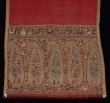
Kashmir embroidery is one of the most famous styles of decorated needlework from the Indian subcontinent.It originates from the Jammu and Kashmir region of the northwestern part of South Asia It is also known as Kashida embroidery. Traditionally, the cloth for this type of work was woven and then decorated by embroiderers (rafugar), often from the same (extended) family.
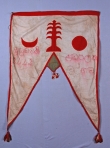
The Nicobar Islands form an archipelago in the eastern Indian Ocean. They lie about 150 km north of Aceh on the island of Sumatra (Indonesia). Although they lie about 1,300 km southeast of the Indian subcontinent, the Nicobar Islands, together with the Andaman Islands, form the Union Territory of Andaman and Nicobar Islands, which, since 1950, have come under the jurisdiction of India.
Bella Phelps (1820-1893) was the daughter of the wine shipper, Joseph Phelps and his wife, Elizabeth Phelps. They lived on the island of Madeira and Joseph Phelps co-owned a firm (since 1804 called Phelps, Page & Co) that had established a wine trade network between Britain and Madeira.
Kakinohanazashi is the Japanese term for the Persimmon flower motif. WV
Komezashi is the Japanese term for the rice stitch, used among others for Shonai sashiko. WV

The famous Tournament of the so-called 'Field of Cloth of Gold' (in French: Le Camp du Drap d'Ort) took place in 1520 in the northwest of France and marked a meeting between Henry VIII of England and Francis I of France. The site was named after the tents and costumes splendidly decorated with cloth of gold, a type of fabric normally woven with a silver gilt weft thread.

The so-called Göss chasuble is a thirteenth century silk garment now housed in the Museum für Angewandte Kunst in Vienna, but originating from the former Benedictine abbey/convent of Göss (Stift Göss), in Styria, Austria. The convent itself was closed in 1782. This vestment and other pieces from the Abbey are generally ascribed to the Abbess Kunegunde (1265-1321) and were to be worn by priest, deacon and sub-deacon.

The London Embroidery School is a subsidiary of the embroidery company of Hawthorne & Heaney,. The School organises classes and weekend workshops, and sells all sorts of embroidery materials. The School is located at Hawthorne & Heaney, 59 Brewer Street, Soho, London W1F 9UN.
More...

The Lier Centre for Textile Arts (Liers Centrum voor Textiele Kunsten) is established in the former chapel of the St Barbara and St Beatrice almshouse.
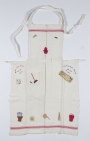
The Rijksmuseum in Amsterdam holds an embroidered apron that was worked by Mrs Maria Christina Coppoolse (acc. no. NG-1999-18-A). The embroidery includes the texts, in the left upper corner: 'KRAMAT KAMP BATAVIA / 1943 - 1945' and in the right upper corner: 'Perlindoengan Tjihapit Bandoeng/ 2604-1944'.
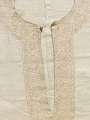
Indian craftsmen, especially from Bengal, were allegedly introduced to Portugal from the sixteenth century. The Victoria and Albert Museum, London, has a linen smock from Portugal dating to the first half of the seventeenth century and produced in the so-called Indo-Portuguese style, perhaps by Indian embroiderers living in Portugal.

The collection of the Rijksmuseum in Amsterdam includes a pair of early seventeenth century embroidered gloves for a bride (acc. no. BK-1978-48-A). They are made of waxed leather, decorated with silk, lace, gold thread and paillettes.