

Kalaga from Myanmar
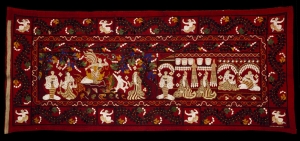
The Victoria and Albert Museum in London, UK, houses a late nineteenth century kalaga from Myanmar (Burma). It measures 293.5 x 124.5 cm and has a ground material made of wool. It has an appliqué decoration made of cotton, wool, and felt, embroidered, and further decorated with braids and sequins, and with some painting.
Kalaga
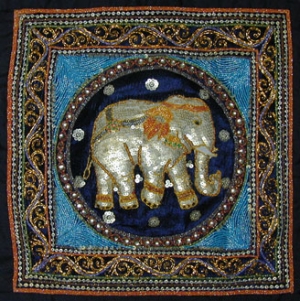
Kalaga (ကန့်လန့်ကာ; 'curtain') is the local name for a traditional type of decorated wall hanging from Myanmar (Burma), and in particular from Mandalay and its environs.
Irish Lace
The production of Irish lace was promoted at the end of the nineteenth century by the Donegal Industrial Fund. This fund was established in 1883 by Alice and Ernest Hart, who wanted to help the destitute of Donegal by offering local women training in weaving, lace making and embroidery.
'Beyond Peacocks and Paisleys'
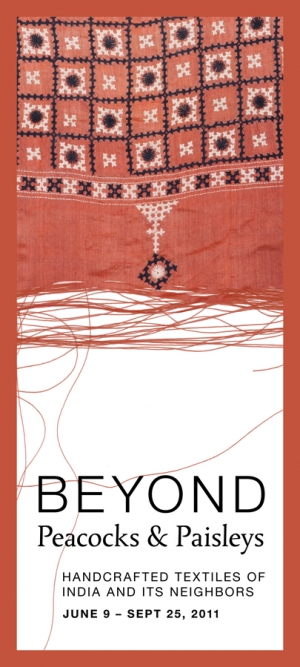
'Beyond Peacocks and Paisleys: Handcrafted Textiles of India and its Neighbors,' was the title of an exhibition at the Goldstein Museum of Design, University of Minnesota, between 9 June - 25 September 2011.
Embroidered Wall Covering
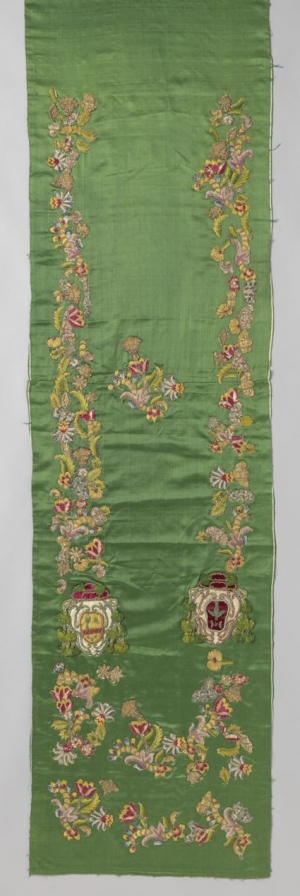
The Rijksmuseum in Amsterdam houses a long length of embroidered wall covering. Its ground material is made of green silk, and the decoration includes applied flower stems, which are embroidered with silk, silver and gold thread. The embroidered decoration includes two applied coats of arms of prelates, made of silk and velvet. Both of them are covered with a red hat (for a cardinal) and tassels.
Lagartera embroidery
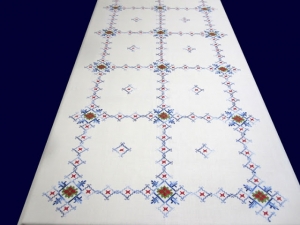
Lagartera embroidery, or Lagartera work, is an ancient hand embroidery tradition that originates from the Spanish town of Lagartera, near Toledo. It is known from at least the sixteenth century, and is often described as reflecting Moorish influences.
Indian chintz, c. 1700
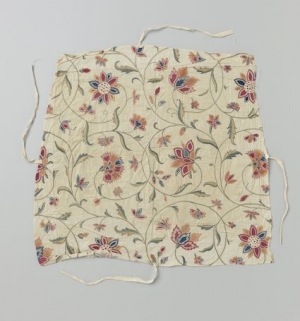
The Rijksmuseum in Amsterdam holds a piece of cloth, originally perhaps intended as a bed spread but later used as upholstery for a chair, which is in fact a beautiful piece of chintz (sits in Dutch), perhaps originating from India, dating to c. 1700. Made of cotton with silk thread (ari-) embroidery, it measures 56 x 51 cm. It is decorated with scrolls and floral motifs.
Woman fainting
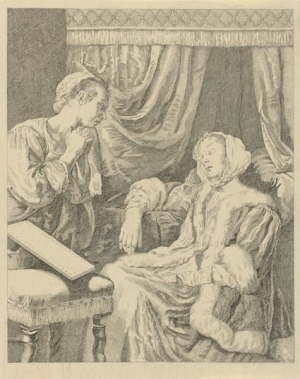
The Rijksmuseum in Amsterdam houses a number of prints of the same etching, which was made by the Leiden craftsman, Pieter de Mare (1758-1796), after a drawing by the Leiden artist, Frans van Mieris (1635-1681). The etching and prints were made between 1768 and 1784. The print measures 24.4 x 19.4 cm.
Chequered cross stitch
See bi-coloured cross stitch. Also referred to as the checked cross stitch.
Osterteppich
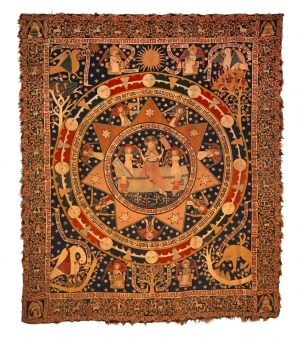
The Museum für Kunst and Gewerbe in Hamburg, Germany, houses an Osterteppich ('Easter carpet') that has been dated to AD 1504 and was apparently made at Klosterlüne, Germany. It measures 450 x 420 cm and is made of linen and wool and embroidered with the Kloster stitch.