

Plate
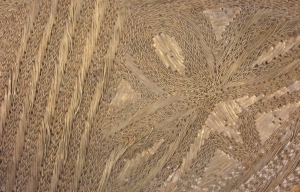
Plate is a form of metal thread made from a narrow, flat strip of metal. There are three main types of metal plate: a) narrow plate, being a flat strip of shiny metal, approximately 2 mm in width; b) broad plate, which is a broad flat strip of shiny metal 3-4 mm in width; c) whipped plate, which is a broad, flat, shiny metal plate with a wire wrapped around the plate at an angle. The three forms, when applied, are couched down in the same way.
Milliary Wire
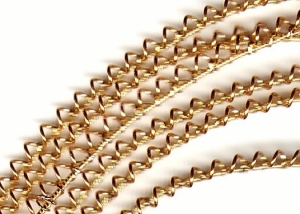
Milliary wire is a form of metal thread made from a central metal core with another metal thread wound around it. Milliary wire is normally couched down onto the ground material with a thread of the same colour, so that the stitches are not visible. Milliary wire is generally used as an outlining thread.
Rococo
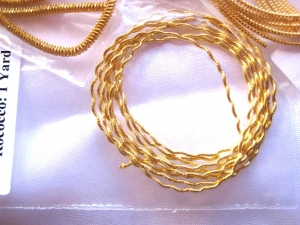
Rococo is a form of metal thread made from a fine wire tightly wrapped around a cotton core. The cord has a wavy (kinked) serpentine appearance. Rococo is comparable to crinkle cordonnet, but it is not as easy to bend, and the waves in the thread are far more even.
Flat Worm
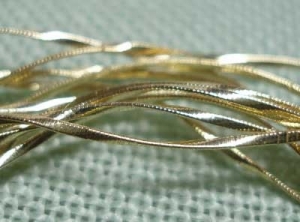
Flat worm (also called oval thread) is a form of metal thread made from a flattened metal strip that is loosely wound around a core yarn. This gives it a spongy feel. The thread is then lightly flattened so that the finished appearance is similar to broad plate, but is more flexible and therefore easier to handle while stitching. The thread is normally couched down with a thread with the same or contrasting colour.
Crinkle Cordonnet
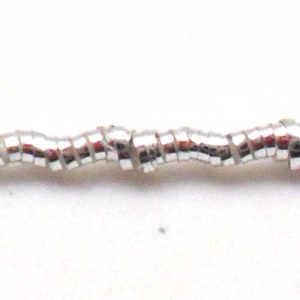
Crinkle cordonnet is a form of metal thread made from a fine wire tightly wrapped around a cotton core. The cord has a wavy (kinked) serpentine appearance. Crinkle cordonnet is normally couched down with a sewing thread with the same or a contrasting colour.
Passement
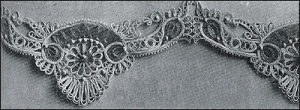
Passement is an archaic term for both braids and laces that were applied flat to clothes or as a border to a curtain, etc. In particular the term was associated with a metal thread braid used to edge a garment. The term comes from the French word passement, and it was in wide-spread use in Britain from the fifteenth to the early seventeenth centuries, at what time the term passement was being replaced by dentelle (Fr: lace).
Passementerie
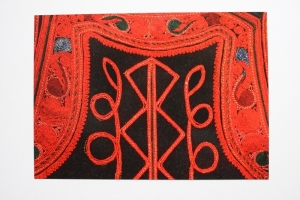
Passementerie is a general term used for fringes, gimps, ornamental cords, tassels, trimmings and so forth that are sewn down onto a garment or textile of some form. The term can also be used to describe a form of applied embroidery, whereby a flexible cord or braid is couched down in a decorative pattern onto a ground material.
Morris, May (1862-1938)
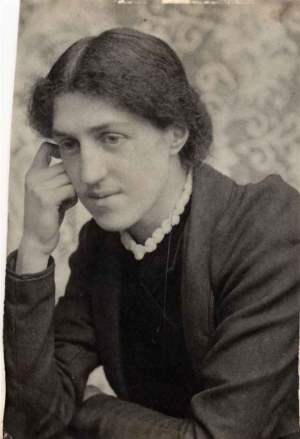
May Morris was the younger daughter of the artist and designer, William Morris and his wife, Jane Morris (née Burden). She was an artist, jewellery maker, writer and editor as well as an embroidery designer. May Morris was involved in her father’s work, notably for the Arts and Crafts Movement and the Art Needlework movement.