

Sybil Carter Indian Lace Association
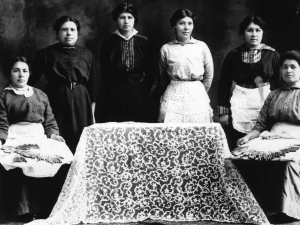
The Sybil Carter Indian Lace Association is an early twentieth century USA group that organised schools for teaching various types of lace making to native Americans. The first school was set up by Sybil Carter in about 1889, following an invitation by Bishop Henry Whipple for her to teach lace making to Ojibwe women in the White Earth Reservation (northwestern Minnesota).
Singer Sewing Machine Company
The Singer Sewing Machine Company was founded by Isaac Merrit Singer (1811-1875), an American inventor and businessman. Singer had a long and varied career. He initially moved to Boston (USA), a centre for the printing trade, where he tried to find financial backers for his type-carving machine. He rented a workshop from Orson Phelps, who built and repaired Lerow and Blodgett sewing machines.
Singer Sewing Machine
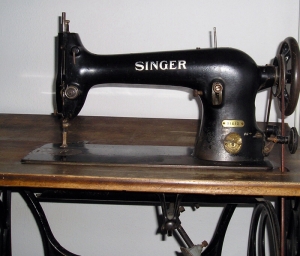
The Singer sewing machine is a brand of domestic sewing and embroidery machines developed in the mid-nineteenth century in the USA.
Singer, Isaac Merrit (1811-1875)
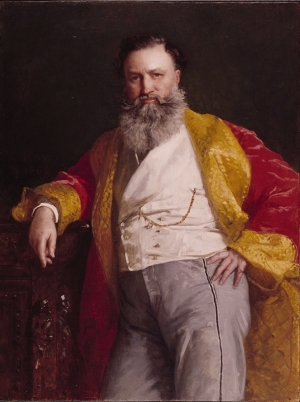
Isaac Merrit Singer was an American inventor and businessman who was involved in the development of hand sewing machines and the Singer sewing machine. Singer was born in Pittstown, New York, the son of German immigrants. He worked as a mechanic and cabinet maker, then as an actor in a travelling troupe. Singer's first patent, in 1839, was for a machine that drilled rock.
Jane Seymour, by Hans Holbein the Younger
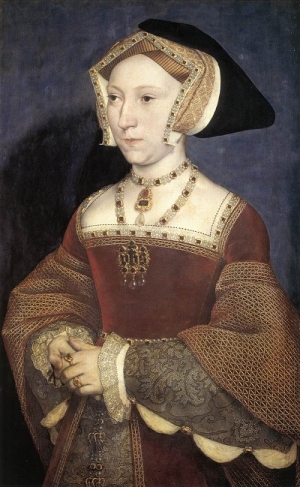
The portrait of Jane Seymour (1508-1537) that was painted by the German artist Hans Holbein the Younger (1497-1543), is of particular interest for its embroidery details. The painting, now in Vienna, dates to about 1536/7. Jane Seymour was the third wife of King Henry VIII of England. The painting was made shortly after her marriage in 1536.
Rug Canvas
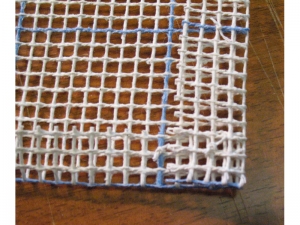
Rug canvas has a meshof strong, cotton threads. This type of canvas is made by twisting two warp threads around each other lengthwise, and locking them around two weft threads at regular intervals. This locking action is required to ensure that the threads cannot be separated and that they make a stable ground material.
Reticella
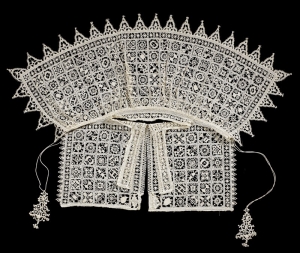
Reticella (Italian, ‘a small net’) is an extreme form of cutwork lace, and thereby classed as a form of embroidered lace. It dates from the late medieval period and involves the large-scale removal of squares of woven ground cloth, usually linen, that are filled in with embroidered patterns. Later reticella used a grid made of thread rather than a cloth ground.
Quilter

Quilter is a term used in English-language quilting groups to refer to either of two people making quilts. These two are: 1. the person who designs and/or makes a quilt top, or 2. the person who stitches or ties the layers of a quilt together. This may or may not be the same person who designs and/or stitches the quilt top.
Pine Burr
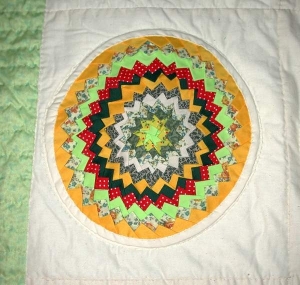
Pine burr is a three-dimensional quilt style, also known as pine cone, in which overlapping triangular swatches are placed in a circular pattern, starting from the centre. This style was very popular with African-American quilt makers in the southern USA throughout the twentieth century.
Phrygian Embroidery (Turkey)
There is a reference to what is generally translated as 'Phrygian embroidery' in Pliny the Elder’s (AD 23-79) Naturalis Historia, which was completed in c. AD 77.