

Commemorative Quilts

A commemorative quilt is especially made to mark a personal, family or institutional event or situation. These quilts may be made by individuals or groups. Some commemorative quilts are purely decorative, others have names, dates and/or inscriptions.
Commemorative Embroidery
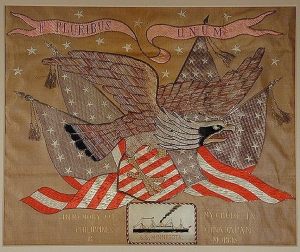
A commemorative embroidery is especially made to mark a personal, family or institutional event or situation. Commemorative embroideries can take the form of a single panel, such as a commemorative sampler, small memorial cards, or large-scale panels that may be many metres long.
Coggeshall Lace
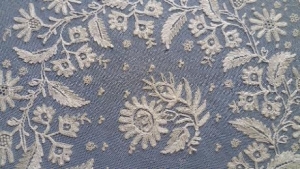
Coggeshall is a town in Essex (England) noted for its tambour embroidery on net, called Coggeshall lace or Coggeshall tambour lace, and sometimes Coggeshall embroidery. The industry was started around 1812, when a French (or possibly Walloon) refugee called M. Draygo (also written Drago) and his two daughters came to Coggeshall.
Cloth of State (UK)
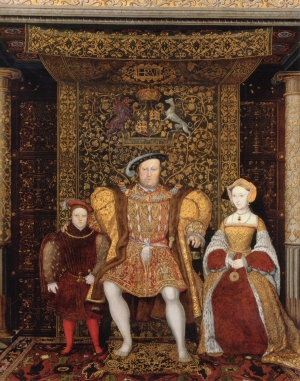
By the sixteenth and seventeenth centuries, the Cloth of State in England was a set consisting of a canopy (called a ceeler) and a long back (tester) hung against the wall. The set hung above and behind the monarch's throne. It was often made of very rich damask, brocade or velvet cloth and embroidered with armorial (such as a coat-of-arms) designs.
Check Canvas
Check canvas is a form of canvas, in which the warp threads are worked in three sets of two threads, and the weft threads are worked in three sets of four threads. GVE
Chefchaouen Embroidery (Morocco)
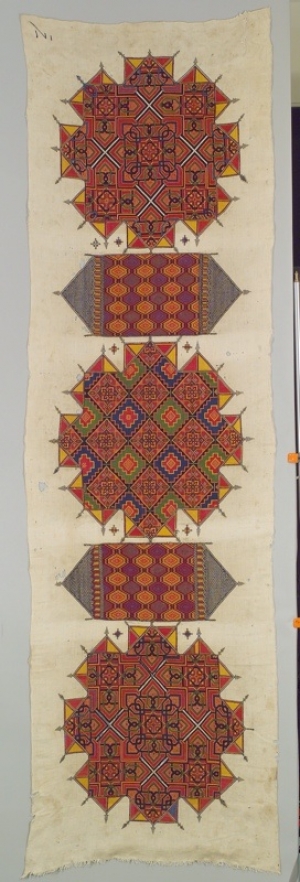
Chefchaouen embroidery derives from a city with the same name, which is located in the Rif mountains of northern Morocco. Founded in 1471, the city soon became home to Jewish and Muslim exiles fleeing the Spanish Reconquista. The embroidery traditions of the various religious and ethnic groups all affected later Chefchaouen production.
Cennini (c. 1370 - c. 1440)

Cennino d'Andrea Cennini was an Italian painter who also produced patterns for embroidery and lace. He is most famous for his book, Il libro dell’Arte, which includes details of various painting techniques then in current use.
Casdagli Sampler
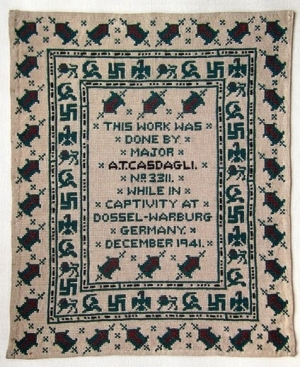
The Casdagli sampler is a form of trench art worked in 1941 by a British army officer, Major Alexis Casdagli. He was captured and imprisoned by the German forces early in the Second World War (1939-1945). After six months in a German Prisoner of War (POW) camp, Casdagli was given some embroidery canvas.
Calico

Calico is originally a cotton cloth imported from the East (India). It is named after the Indian city of Kozhikode (Kerala State; known by the English as Calicut) in southwestern India. From about 1578 onwards the word calico has come to mean, in England, a plain white unprinted, and unbleached cotton cloth. It may contain un-separated husk parts.
Jane Bostocke's Sampler

Jane Bostocke's sampler is the earliest surviving British example of this type of embroidery. The sampler was worked by Jane Bostocke of Langley (Shropshire, England) and includes the date 1598. The sampler was made to commemorate the birth of her cousin, Alice Lee, two years previously.