

Tirai (Indonesia)
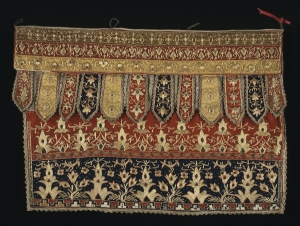
The Los Angeles County Museum of Art houses an embroidered ceremonial hanging (tirai) from eastern Sumatra, Indonesia, which dates to the nineteenth century. The embroidery is worked with silk and gold thread embroidery, with pieces of mica and with lace made from metallic thread, on a woollen ground material. It measures 62.8 x 89.2 cm.
Orphrey Cross
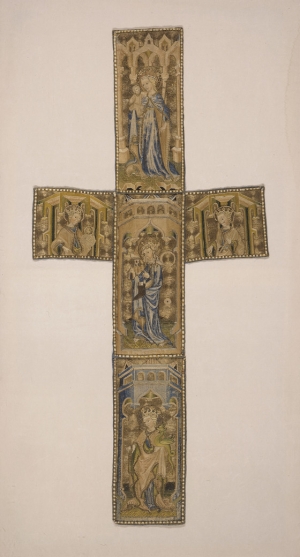
The Los Angeles County Museum of Art houses an embroidered orphrey cross from Germany, which dates to the early fifteenth century. The embroidery is worked with silk and gold thread embroidery, using satin stitch and couching on the linen ground material.
Ramayana Rumal
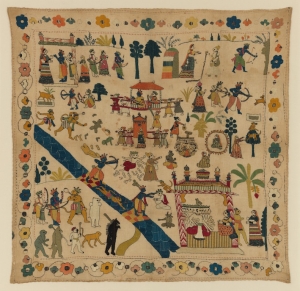
The Metropolitan Museum of Art in New York houses a chamba rumal (Hindi for handkerchief or covering; Chamba is the historical name for part of the province of Himachal Pradesh) in the northwest of the Indian subcontinent. It is made of cotton with silk, tinsel and metal thread embroidery. It measures 66 x 63.5 cm and has been dated to the eighteenth century.
Man's Coat (India)
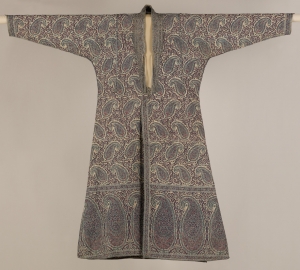
The collection of the Metropolitan Museum of Art in New York includes a man's coat, a choga, which probably dates to the first half of the nineteenth century and may derive from Kashmir in the northwest of the Indian subcontinent. It is 133 cm long and 75 cm wide at the bottom. It is made of wool and is decorated with metal thread embroidery and applied braids.
Kashmir Coat
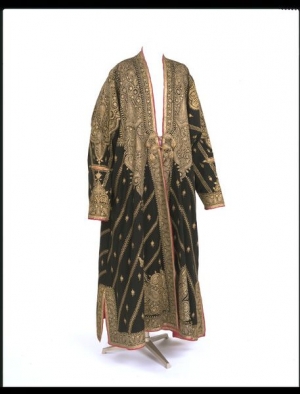
The Victoria and Albert Museum in London houses a nineteenth century Kashmir coat made of black wool with gold thread embroidery. The embroidery includes the paisley motif.
Eighteenth Century Chamba Rumal
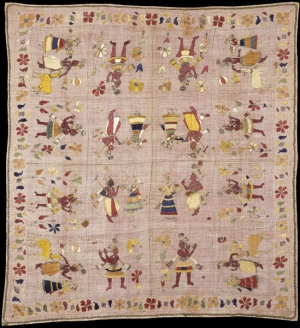
The Victoria and Albert Museum in London houses an eighteenth century chamba rumal (coverlet named after the former principality of Chamba, in the modern Himachal Pradesh state, Northwest India). It measures 89 x 82 cm and is made of cotton with silk thread embroidery. The decoration of the rumal is divided into sixteen panels, each containing a scene relating to Krishna.
Chamba Rumal with Ganesha
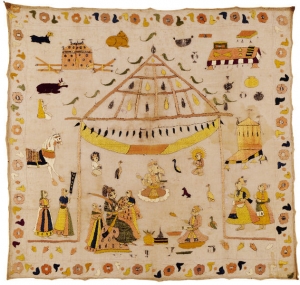
The Victoria and Albert Museum in London houses a chamba rumal (coverlet from the former principality of Chamba, in the modern Himachal Pradesh, Northwest India). It is made of muslin with silk thread embroidery. The rumal shows a palace scene with Ganesha in the background. The embroidery, as will all rumals, is reversible and worked with a type of double darning stitch.
Chamba Rumal
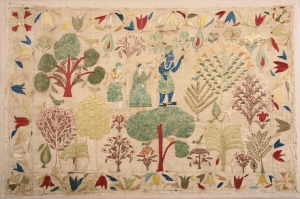
Chamba rumals are embroidered coverlet traditionally produced in the northwest of the Indian subcontinent, in the ancient principality of Chamba, now part of the modern province of Himachal Pradesh, in and around the district of Kangra and its capital, Dharamshala.
Chamba Rumal with Krishna and his Gopis
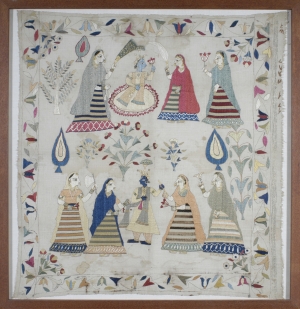
The Los Angeles County Museum of Art houses a chamba rumal from the late eighteenth or early nineteenth century. It originates from Himachal Pradesh, perhaps from Kangra, the traditional centre of the old principality of Chamba. The rumal (coverlet) measures 77 x 72 cm. It is made of cotton with silk thread embroidery and the decoration is reversible. It shows Krishna being adored by gopis (shepherdesses).
Empress Kneels Before Saint Martin
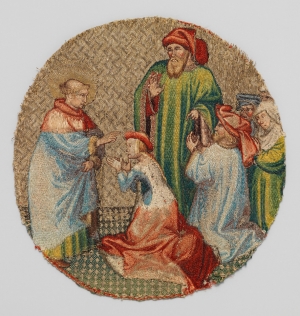
A roundel with a diameter of 15.5 cm with embroidery carried out in the or nué tradition, popular in the Netherlands in the fifteenth and sixteenth centuries, is housed, among other or nué examples, in the Metropolitan Museum of Art in New York. It dates to the early fifteenth century and shows two scenes from the medieval legendary story of Saint Martin. The embroidery is carried out in silk and silver thread on a linen background.