

Wall Hanging Mary Queen of Scots
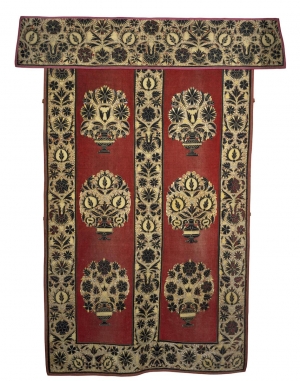
The National Museums Scotland holds an embroidered wall hanging that allegedly used to decorate the bed of Mary Queen of Scots at Loch Leven Castle, Kinross-shire, Scotland. It is made of red wool with a napped surface (creating a felt-like surface) and decorated with black velvet appliqué and silk thread embroidery.
Drawing of Japanese Bast Fibre Tunic
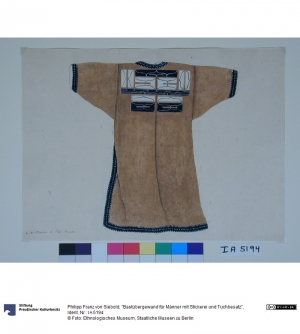
The Ethnologisches Museum in Berlin holds a drawing of an embroidered, Japanese bast fibre tunic. The drawing was collected by Philipp Franz von Siebold (1796-1866). It shows the type of tunic, worn by the Ainu, discussed elsewhere in TRC Needles. The German physician Von Siebold worked for the Dutch government at Deshima between 1823 and 1829, and settled in Leiden, The Netherlands, upon his return from Asia.
Derwish Cap, Tabriz, Iran
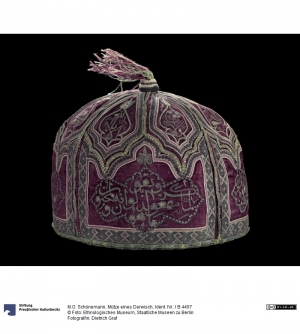
The Ethnologisches Museum in Berlin holds a dervish cap from Tabriz, Iran. It has a circumference of 56 cm and is 14 cm high. It is made of silk, wool and metal thread. The main embroidery parts are worked in chain stitch. It dates to the early twentieth century or before.
British Sampler in Berlin Collection
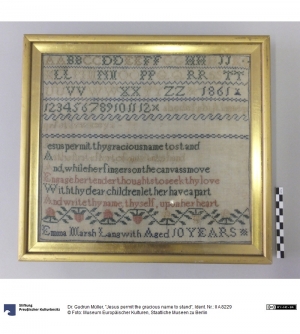
The Ethnologisches Museum in Berlin houses a sampler from Britain, completed in 1861 by Emma Marsh Langwith, who at the time was ten years old. The embroidery is worked in cross stitch, and the sampler measures 31.3 x 24.3 cm.
Woman's Shirt, Xinjiang, China
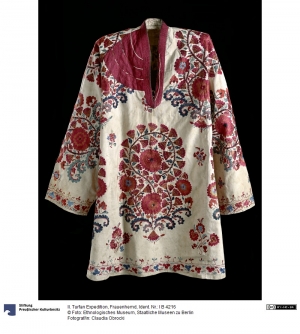
The Ethnologisches Museum in Berlin houses an embroidered woman's shirt from Yarkand, Xinjiang, in the most western part of China. It dates to the late nineteenth or early twentieth centuries, and was acquired during the Second Turfan Expedition (1904-1907), led by Albert von Le Coq (1860-1930). The fabric is made of cotton. The embroidery is worked with silk. The tunic measures 123 x 208 cm.
Man's Shirt, Peru
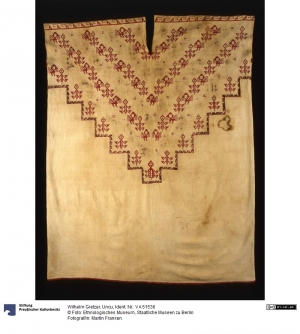
The Ethnologisches Museum in Berlin houses a man's shirt from Peru. It dates to the second half of the nineteenth century, or earlier, and was acquired by the German textile merchant and collector, Christian Theodor Wilhelm Gretzer (1847-1936). The fabric is made of cotton. The tunic measures 90 x 72 cm. The embroidery is worked with silk, using cross stitch.
Commemorative Panel, German Military Reservist, 1902
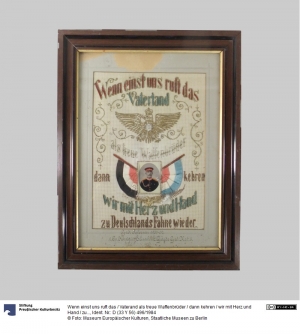
The Ethnologisches Museum in Berlin houses an embroidered commemorative panel, issued to a German officer who left active service to become a reserve officer. The panel measures 49 x 36 cm. The machine embroidered texts are worked in wool, chenille and gold and silver thread.
Bast Fibre Tunic, Japan
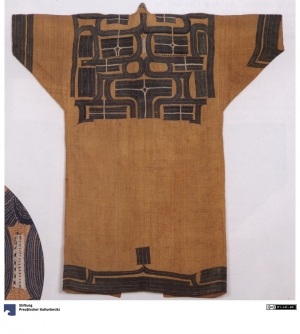
The Ethnologisches Museum in Berlin houses a bast fibre tunic from among the Ainu in Hokkaido, Japan. It dates to the second half of the nineteenth century, or earlier, and was acquired by Max August Scipio von Brandt (1835-1920). The fabric is made of the bast of the Atsui tree. The tunic measures 123 x 115.6 cm. The embroidery is worked with cotton.
Embroidered Mitts, Germany
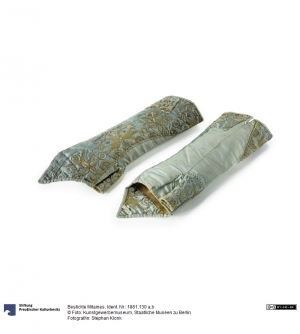
The Ethnologisches Museum in Berlin houses a pair of early eighteenth century mitts, which were made in Germany. They measure 31.5 x 10 cm. The gold thread embroidery is partly worked free-style and partly worked over a card template.
Bukharan Horse Blanket
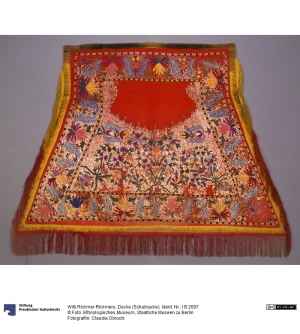
The Ethnologisches Museum in Berlin houses a cotton horse blanket (chabrak), acquired c. 1900 by Willi Rickmer Rickmers (1873-1965). It is decorated with embroidery and paillettes.