

Hand-Book of Needlework, 1842
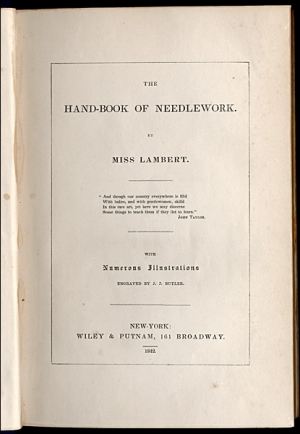
Hand-Book of Needlework was published in 1842 and written by Miss Frances Lambert. The book contains brief historical introductions to the various technical details. The book, published simultaneously in England and America, was an immediate success and went through a series of reprints and revised editions, including various pirate editions in the USA, including The Ladies' Complete Guide to Needlework and Embroidery (1859).
The Illuminated Book of Embroidery, 1847
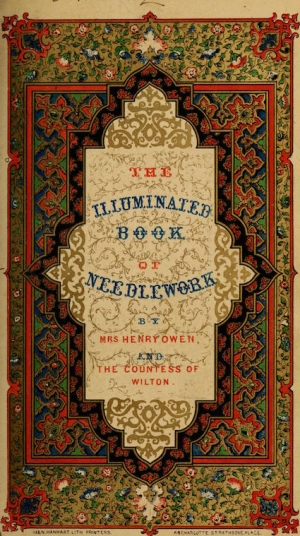
The Illuminated Book of Embroidery was first published in 1847 and was bound together with the previously published The Art of Needlework (1840; now called A History of Needlework), which was published by Mary Margaret Egerton, Countess of Wilton, but authored by Mrs. Elizabeth Stone.
The Art of Needlework, 1840
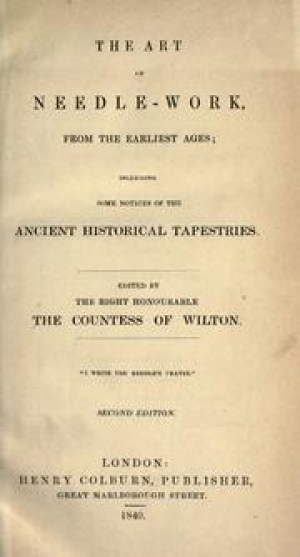
The Art of Needlework, from the Earliest Ages; including some notices of the ancient historical tapestries was first published in 1840. It was edited by Mary Margaret Egerton (1801-1858), Countess of Wilton, and published by Henry Colburn.
Washington Square

'Washington Square' is a short novel by the American author Henry James (1843-1916), in which embroidery (also called 'fancy-work') plays a major role. Henry James published the novel in serial form in 1880, in Cornhill Magazine and Harper's New Monthly Magazine.
Emboidered Boots from Mongolia
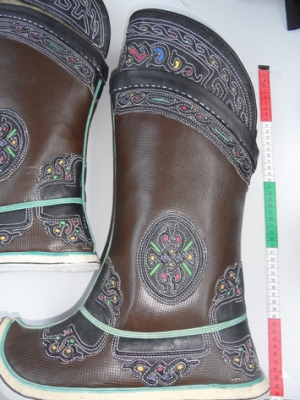
The Textile Research Centre in Leiden houses a pair of embroidered boots from Mongolia. They were acquired in 2008. They are made of felt, leather, vegetable and synthetic fibre. They are 53 cm high and 32 cm long.
Waistband, Mexico

The Textile Research Centre in Leiden houses a machine woven waistband from Mexico, 54 cm in diameter, which is embroidered in cross stitch, and further embellished with red and blue tassels. It belongs to the ethnic group of the Huichol, in the west of the country.
Double sided embroidery of a cat, China
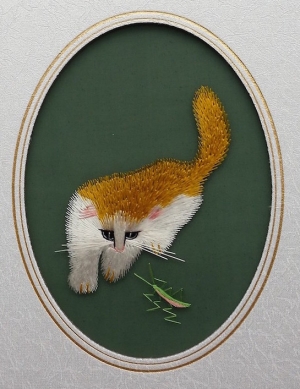
The collection of the Textile Research Centre in Leiden includes a double sided embroidery of a cat, from late twentieth century China. The embroidery measures 23 x 17 cm. The embroidery itself is made of silk and worked with a random, filling stitch, and is placed inside a protective cover. The cat is playing with a praying mantis.
Yurt Bag
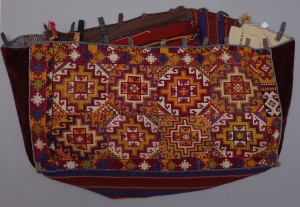
The Textile Research Centre in Leiden houses a yurt bag from the Uzbeks in Afghanisan, dating to the mid-twentieth century. It measures 80 x 38 x 24 cm. It is made of a cotton ground material with silk embroidery.
School Sampler, 1904
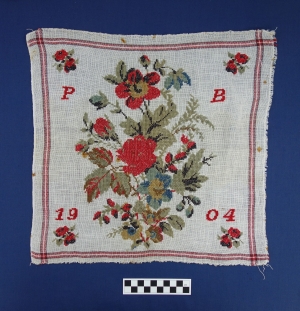
The collection of the Textile Research Centre in Leiden includes a sampler, 36 x 35 cm, which is made of cotton and embroidered with perlé thread. The central motif is a bunch of stylised flowers. In addition, there are the initials P and B and the date, 1904.
Cloth from Surinam, South America

The collection of the Textile Research Centre in Leiden includes a cloth, 70 x 63 cm, which is made of cotton and embroidered with simple scenes taken from daily life. It dates to the 1930's and originates from Surinam in South America.