

British Military Style Jacket from Bethlehem

The Textile Research Centre in Leiden houses a jacket from Bethlehem, which dates to the 1920's and is made of factory-made velvet and decorated with hand embroidered couching showing stylised flowers and geometric motifs.
Knitting Sampler
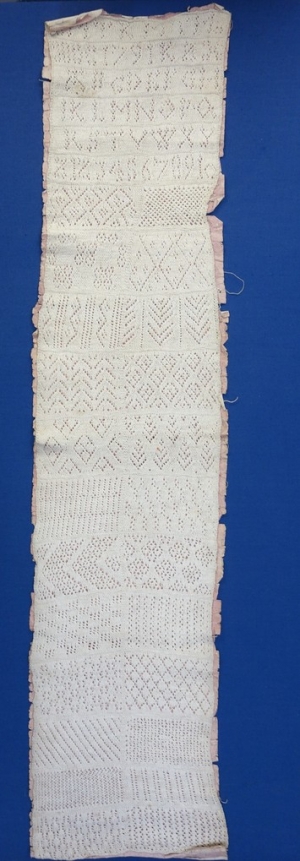
The Textile Research Centre in Leiden houses a remarkable knitting sampler (in Dutch called a breirol), which may be one of the oldest extant examples in Europe. It is dated to AD 1791 and was acquired together with a large group of Hungarian embroideries.
Moore, Doris Langley (1902-1989)
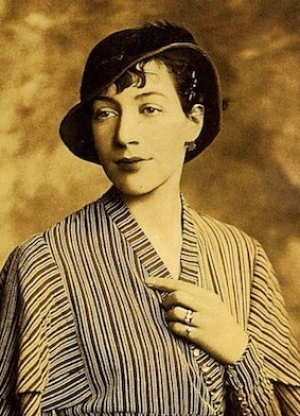
Doris Langley (-Levy) Moore was an important British fashion historian. She founded the Museum of Costume in 1963, which since has been renamed the Fashion Museum, in Bath. She was also an expert on Lord Byron, and in the 1940's wrote the scenario for a ballet, The Quest.
Shi' ite Protective Prayer Cloth, Afghanistan
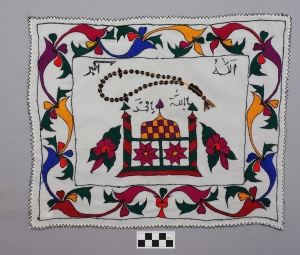
The Textile Research Centre in Leiden has a protective prayer cloth from Afghanistan (TRC 2007.1132). It measures 29.5 x 29 cm. It is made of cotton with silk thread embroidery. The techniques used are satin stitch and double running stitch.
Hearth Screen

The Nederlands Openluchtmuseum in Arnhem, Gelderland, the Netherlands, houses an embroidered hearth screen, somewhat in Biedermeier-style, which was used in the summer to hide the place where during the winter the hearth would be lit. The screen was made on the occasion of the marriage between Dirk Bezemer (1867-1938) and Dirkje Nolman (1869-1938) on 5 August 1891 in Delft, the Netherlands.
Civic Crest of Nijmegen, for Louis Napoleon
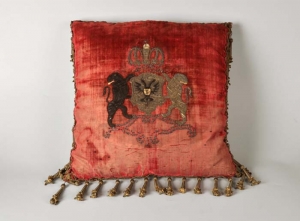
The Museum Het Valkhof in Nijmegen, Gelderland, the Netherlands, houses an embroidered cushion from the town of Nijmegen, Gelderland, which was used to present the keys of the town to Louis Napoleon (1778-1846) when he visited the place on 24 July 1808. The keys were presented by the Nijmegen mayor, J.E. Sanders van Well (1739-1814).
Bridal Bodice from Marken, The Netherlands,
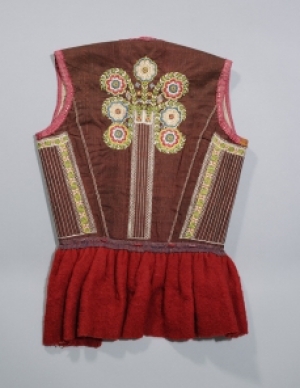
The Nederlands Openluchtmuseum in Arnhem, houses an embroidered bodice from the island of Marken, in the former Zuiderzee, now the IJsselmeer. Locally it is called a bruidsrijglijf. It is made of silk and embroidered with silk. The red band along the bottom is made of wool. Small bustle-style cushions were suspended from this band to broaden the apperance of the hips.
Bodice from Zeeland, 1825

The Nederlands Openluchtmuseum in Arnhem, houses an embroidered bodice from Zeeland, in the southwest of the country. Locally called a beuk, and more nationally called a kraplap, this type of garment consists of two panels sewn together along one side with an opening in the centre for the head. The beuk is made of linen and embroidered in cross stitch with silk. Cotton is used for the sewing.
Silk Embroidered Scroll Painting, China
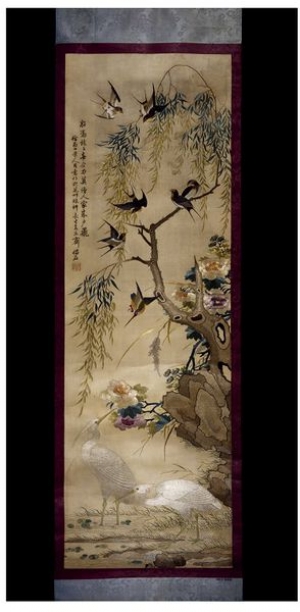
The Victoria and Albert Museum in London houses an embroidered scroll painting from China, which dates to the third quarter of the nineteenth century. It is made of silk and embroidered with silk thread, and measures 160 x 43 cm. The embroidery shows a willow tree, kingfishers and swallows.
Embroidery Transfer of Weldon's
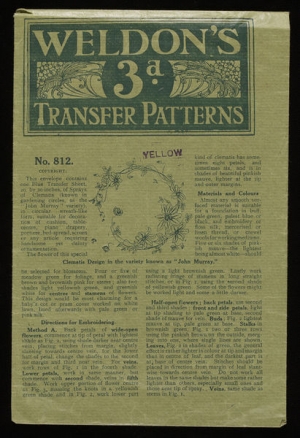
The Victoria and Albert Museum in London houses the packaging of an embroidery design published by Weldon's Ltd. It dates to the early twentieth century and measures 13.9 x 21.2 cm. This is Weldon's design No. 812, of the Clematis, and its variety known as "John Murray".