

Milanese Lace
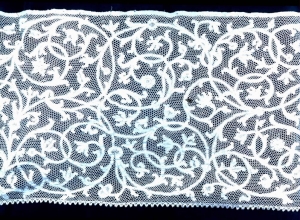
Milanese lace, or Milanese tape lace, is a form of bobbin lace produced in the seventeenth and eighteenth centuries in Milan, Italy. It is characterised by bold leaf, scroll or chain designs, mixed sometimes with animal or human forms. The designs are made up of braids or tapes, that are combined with bars or net. It should not be confused with Point de Milan, which is a nineteenth century Belgian product.
Queen Victoria's Wedding Lace
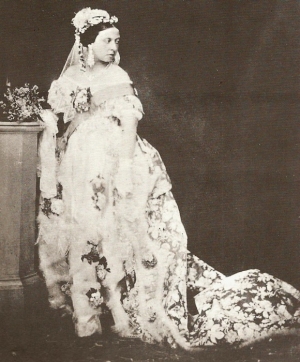
On the 10th February 1840, Queen Victoria married Prince Albert of Saxe-Coburgh and Gotha. Queen Victoria wore a white wedding dress made of silk satin, which was trimmed with a flounce of Honiton lace, from Beer (a village close to Honiton, in Devon), worked under the guidance of Miss Jane Bidney (Jane Washbourne). She also wore lace frills, a bertha, and a white lace veil, also made of Honiton lace from Beer.
Horsehair
Horsehair is sometimes used in needlepoint lace.
Washbourne, Jane (1802-1882)
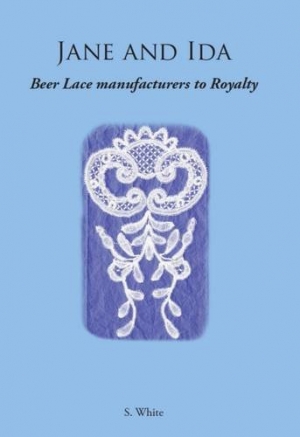
Jane Washbourne, née Bidley, from the village of Beer, Devonshire, was an independent lace dealer who was appointed "Honiton Brussels Point Lace Manufacturer" to Queen Victoria, on 14th August 1837. She organised the production of the lace for Queen Victoria's wedding dress (which she attended, on 10th February 1840) between May and November 1839, for which work some two hundred workers in Beer were employed.
Conservatoire des Broderies de Lunéville

The Conservatoire des Broderies de Lunéville was established in 1998 in Lunéville, France, with the aim of highlighting and preserving the craft of embroidery production, as exemplified in the famous Luneville embroidery, including the broderie perlée et pailletée.
Point de Venice (Belgium)
Point de Venice refers to a needlepoint lace from Venice dating to the seventeenth and eighteenth centuries (often known as Gros Point de Venice). But it is also the name of a Belgian needlepoint lace.
State Museum, Lucknow
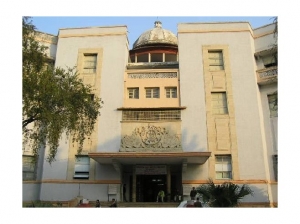
The State Museum in the city of Lucknow, Uttar Pradesh, India, houses an important collection of Indian textiles, including three pieces of historical chikan work, dating to the nineteenth century. Next door to the Museum a new crafts museum is being built (July 2017), which hopefully will display more examples of Lucknow embroideries.
Indian Museum, Calcutta
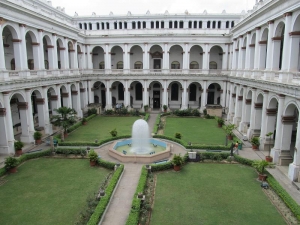
The Indian Museum in Calcutta houses, among others, an important collection of Indian textiles, including chikan work. The museum was founded in 1814 and was closely linked to the Asiatic Society of Bengal (1784). It received items from the India Museum in London when that was closed down and its collection dispersed n 1879.
Crafts Museum, Lucknow
The Crafts Museum in Lucknow, India, established in 1956, houses an important collection of Indian textiles, including chikan work and zardozi (goldwork embroidery).
Bharat Kala Bhawan
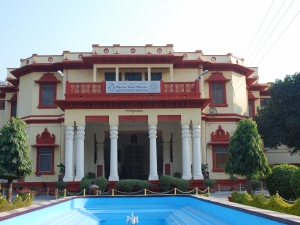
The Bharat Kala Bhawan (भारत कला भवन) is an art and archaeology museum in Varanasi, India. It houses a collection of Indian textiles, and especially chikan embroidery. The Museum was founded in 1920 and is attached to Banaras Hindu University.