

Turkmen Embroidery (Afghanistan)
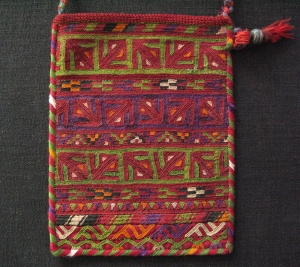
The Turkmen speak a form of Western Ghuz (Oghuz) Turkic, closely related to the languge spoken in modern Turkey, and which now includes many Arabic and Farsi words. At the end of the nineteenth century, the Turkmen region was divided among Afghanistan, Iran and the former Soviet Union. At the end of the twentieth century, the independent republic of Turkmenistan was founded.
Gul-i Pirahan

Gul-i pirahan ('flower of the shirt') is the term for an ornamental roundel on Pashtun garments and other items. They are generally made of felt and covered with symbols and objects of good luck and fertility, such as coloured beads, cowrie shells and metal discs. These roundels are usually applied in pairs and stitched to the upper part of women’s dresses, bags and animal trappings.
Hazara embroidery (Afghanistan)

The Hazaras from central Afghanistan are known for working embroidery on cotton or silk material enlivened by very fine lines of cross or herringbone stitch. Hazara embroidery tends to be a form of counted thread work rather than free style embroidery. It is generally very fine and precize.
Bellinger, Louisa (1900-1968)
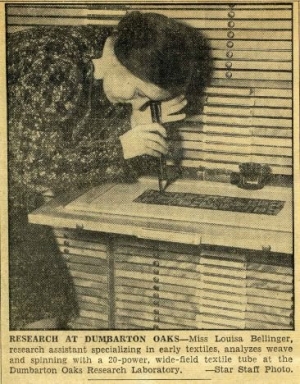
Louisa Bellinger (1900-1968) was an American curator and writer about textiles. She was the daughter of Hiram Pauling Bellinger (1865-1930) and Elizabeth Dwight Raymond (1868-1963). Her brother was Alfred Raymond Bellinger (1883-1978), Dean of the Classics Department of Yale University and a well-known Classicist and Byzantine scholar specialising in Byzantine period coins.
Bertha
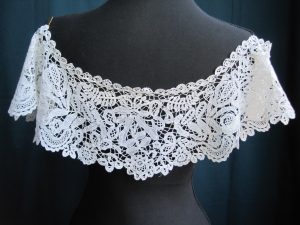
A bertha is a collar made of lace or another thin fabric. It is generally flat and round, covering the low neckline of a dress, and accentuating a woman's shoulders. It was particularly popular in the nineteenth century, but bertha-like garments were also worn in the seventeenth century and are still being worn, as for instance with bridal dresses.
Oaxaca Textile Museum

The Oaxaca Textile Museum (Museo Textil de Oaxaca) is a museum and educational centre in Oaxaca, Mexico, dedicated to textiles, including beadwork and embroideries. The Museum opened in 2006 after the donation of six large, private collections, each consisting of several hundred pieces. The overall collection mainly consists of Mexican and Central American textiles.
Green, Anna Katherine (1846-1935)

Anna Katherine Green (1846-1935) was a bestselling American writer whose first crime fiction novel The Leavenworth Case. A Lawyer's Story (published in 1878) and subsequent books, featuring Amelia Butterworth as the prototype of Agatha Christie's Miss Marple (see here), became required reading at Yale University’s Law School in order to demonstrate the dangers of only using circumstantial evidence.
Imperial and Royal Vocational School for Art Embroidery
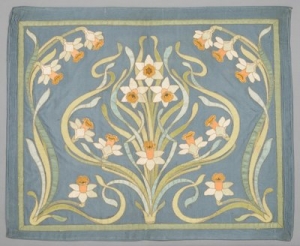
The Kaiserlich-Königliche Fachschule für Kunststickerei ('Imperial and Royal Vocational School for Art Embroidery') in Vienna was founded in 1874 by Emilie Bach with the support of Anton, Freiherr von Banhans, at that time the Minister of Trade. Emile Bach was its first director. The School was apparently closed in 1918.
Textile Museum of Canada

The Textile Museum of Canada (TMC) in Toronto is fully dedicated towards the exhibition, collection, conservation and study of textiles, as a medium for cultural understanding. It has a collection of some 13000 items that cover 2000 years of history, and originate from all over the world. The museum has been particularly active in the digitization of its collection and the development of an interactive environment.
Puzzle Patchwork
See patchwork.