

Needlework as Art, 1886
Needlework as Art is the title of a book by Lady Marianne (Marian) Compton, Viscountess Alford (1817-1888), which was a major influence on late nineteenth century British urban embroidery and how embroidery was perceived. The book was published in 1886 by Sampson Low, Marston, Searle, and Rivington of London.
Embroidery Show
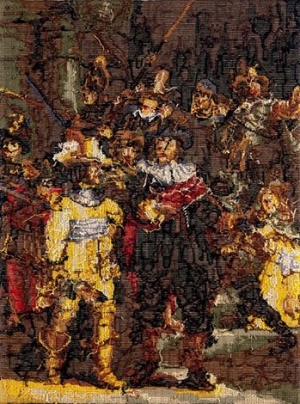
The Embroidery Show was an exhibition that was held in Museum De Fundatie, Zwolle, The Netherlands, from 28 April to 18 September 2016. It showed some one thousand embroideries that were collected since 2005 at various flea markets and other places by the modern Dutch artist, Rob Scholte.
Lakai Uzbeks (Afghanistan)

The Lakai Uzbeks moved from Central Asia in the north and settled in the Kunduz area of northern Afghanistan, after the Bolshevik revolution in Russia. They are particularly known for their embroidery. Their work is characterised by the use of the cross stitch, and the multi-coloured geometric motifs carried out on bags, belts and bands.
American Folk Art Museum
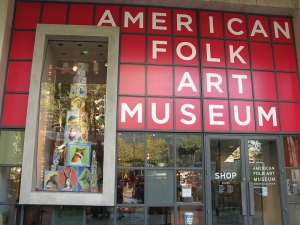
The American Folk Art Museum in New York was established in 1961 and is dedicated to the artistic expressions of self-taught American artists, from the eighteenth century until the present day. The Museum sets up exhibitions, organises educative projects and runs a publication programme. The collection includes some 8,000 items (2016), among which textiles (quilts, samplers), paintings, three-dimensional objects, photographs, etc.
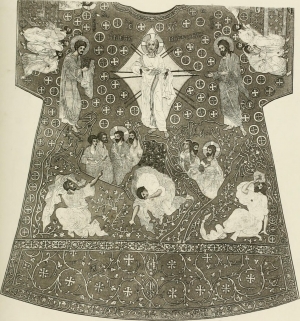
Dalmatic of Charlemagne

The so-called Dalmatic of Charlemagne is held in the Treasury Museum of the Vatican Basilica. However, it is neither originally a dalmatic, nor was it ever worn by Charlemagne. It is probably an imperial garment (a sakkos), made of silk, from the Byzantine empire, and perhaps of an eleventh century date (other scholars suggest a fourteenth century date).
Auriphrygium
The Late Latin term auriphrygium derives from aurum ('gold') and Phrygius ('Phrygian').
Gammer Gurton's Needle

Gammer Gurton's Needle is the title of an anonymous rustic and poetic drama that was written, allegedly, in 1533, and performed at Christ's College, Cambridge, in 1566 or 1567. It is a comedy in which a lost needle plays the major part. Its full title is A Ryght Pithy, Pleasaunt and Merie Comedie: Intytuled Gammer Gurtons Nedl. It was accredited in the past to Bishop John Still, but this association has since been refuted.
Wardle, Elizabeth (1834-1902)
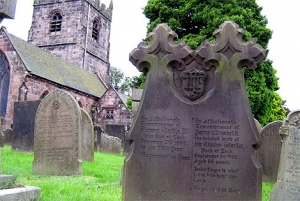
Dame Elizabeth Wardle was an embroideress from Staffordshire. She married Thomas Wardle (1831-1909) in Leek (Staffordshire) in 1857. Her brother George Young Wardle worked for William Morris, who lived and worked in Leek between 1875 and 1878.
Leek Embroidery Society

The Leek Embroidery Society and the associated Leek School of Embroidery were founded in 1879/1880 by the embroideress Elizabeth Wardle and her husband, Thomas Wardle. The Society, initially called the Leek Sewing Circle, produced both domestic and ecclesiastical embroidery work, that was granted prestigious awards for its fineness and high quality. Most of the work, including the dying, took place in Leek, Staffordshire.
The Christian Muse's Birthplace
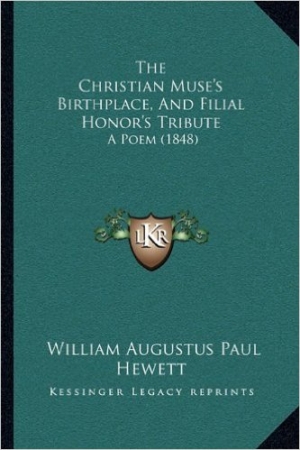
A passage from a poem by William Augustus P. Hewett, called 'The Christian muse's birthplace, and filial honour's tribute, a poem', from 1848, refers to the difficult life of the lace makers in England, who were confronted by the marketing of much cheaper machine-made products.