

Morris, Jane, 1839-1914
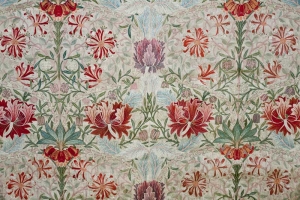
Jane Morris (née Burden; 1839-1914) was the wife of William Morris (1834-1896), and the model and muse for both her husband and for the Pre-Raphaelite English poet, painter and illustrator, Dante Gabriel Rossetti (1828-1882). Jane Morris was also known to be an accomplished embroideress.
Cretan Cushion Cover
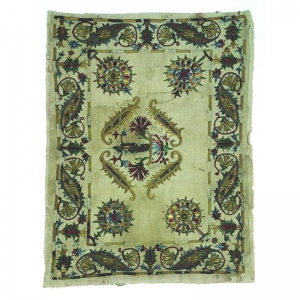
ULITA in Leeds holds a Cretan cushion cover, measuring 45 x 35 cm. It has a border pattern of carnations, lappets and leaves. In the midle is a vase with stylised flowers framed by four leaves. In the corners are four rosette-shaped motifs. The embroidery is worked in herringbone, satin and split stitch. The colours and patterns are characteristically Cretan.
Cloud Collar (China)
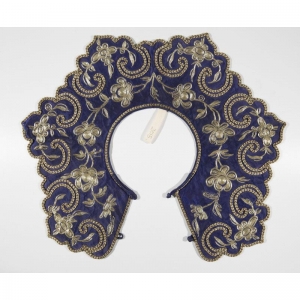
ULITA in Leeds holds a Chinese, hexagon shaped, embroidered 'cloud collar' (40 x 35 cm), apparently for a woman's coat. It is made of blue silk, decorated with metal thread couching. The embroidered motifs are stylised flowers, resembling peonies. It is said to date to the late nineteenth century. The collar was collected in Hong Kong.
Apron Panel with Liu Hai (China)
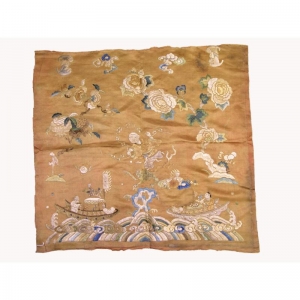
ULITA in Leeds (UK) houses a Chinese, late eighteenth century apron panel. It measures 54 x 57.5 cm and is made of silk. The main Daoist design is that of the boy Liu Haichan playing with the toad. The ground fabric is a red silk satin, now faded to a gold colour. The embroidery is carried out with chain, satin, and seed stitches.
Apron Panel with Qilin (China)
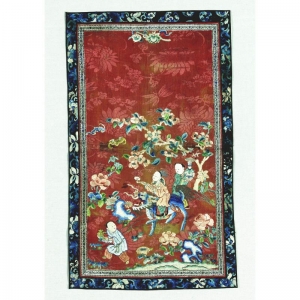
ULITA in Leeds (UK) houses a Chinese, nineteenth century apron panel. It measures 76 x 45.5 cm and is made of silk, cotton and metallic threads. The design is based upon the theme of the 'promising life of the children'. The main theme shows the mythical qilin carrying a boy, together with two other boys.
Agbada Robe (Nigeria)
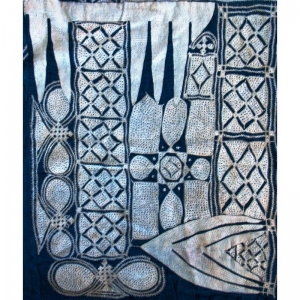
ULITA in Leeds (UK) houses a formal agbada robe for a Yoruba man in Nigeria (c. 1940; 129 x 257 cm). Such a garment is related to the riga robe worn by the Hausas all over West Africa. The robe is made of 48 hand woven strips of etu ('guinea fowl', for its speckled appearance) cloth, which is the very valuable, dark-indigo dyed cotton or silk of the region, and which is characterised by the insertion of white warp (or weft) threads.
Kashmiri Shawl from Leeds, UK
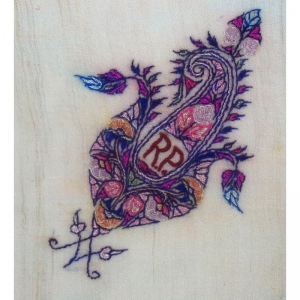
ULITA, an Archive of International textiles, University of Leeds, houses a Kashmiri shawl (267 x 120 cm) from the nineteenth century that was owned by Mrs Emily Herklots (née Bazeley; 1873-1934). She was the wife of the Reverend Herklots (1873-1934), who was vicar of St Georges, near Leeds General Infirmary, and whose family had lived and worked in India since the seventeenth century.
Roman Chain Stitch
See the open chain stitch.
Twisted Daisy Border Stitch
See the Basque stitch.
Point de Sable
See the back stitch.